
As the global commercial real estate and hospitality sectors accelerate their renovations in 2026, the demand for durable, high-quality sanitary fixtures has surged. Procurement directors and wholesale distributors frequently approach manufacturers with a common question: Which stainless steel is best for stainless steel bathroom mirror cabinets? Many assume the answer is a straightforward endorsement of the highest grade available, operating under the assumption that “304 is always better than 201.”
However, choosing the right bathroom mirror cabinet materials is not simply a matter of appearance. The cabinet body must tolerate humidity, water splashes, cleaning chemicals, door movement, electrical components and long-term use. For importers, hotel contractors, distributors and private-label brands, the material decision also affects product positioning, warranty risk, shipping cost, production consistency and total project value.
Stainless steel is one of the strongest options for a metal bathroom mirror cabinet, but the phrase “stainless steel” is incomplete unless the grade, thickness, finish and fabrication quality are specified. A stainless steel mirror cabinet made from 201 stainless steel may perform very differently from one made from 304 or 430. At the same time, a well-designed aluminum cabinet may be a better solution for a weight-sensitive project, while a powder-coated steel or MDF cabinet may be selected for a specific price or style segment depending on the required bathroom mirror cabinet materials.
This guide compares the main stainless steel grades used in stainless steel bathroom mirror cabinets and explains how a stainless steel mirror cabinet performs against aluminum and powder-coated steel based cabinets. It is written for B2B buyers who need to specify the correct material instead of relying on a vague product description.
Quick Answer
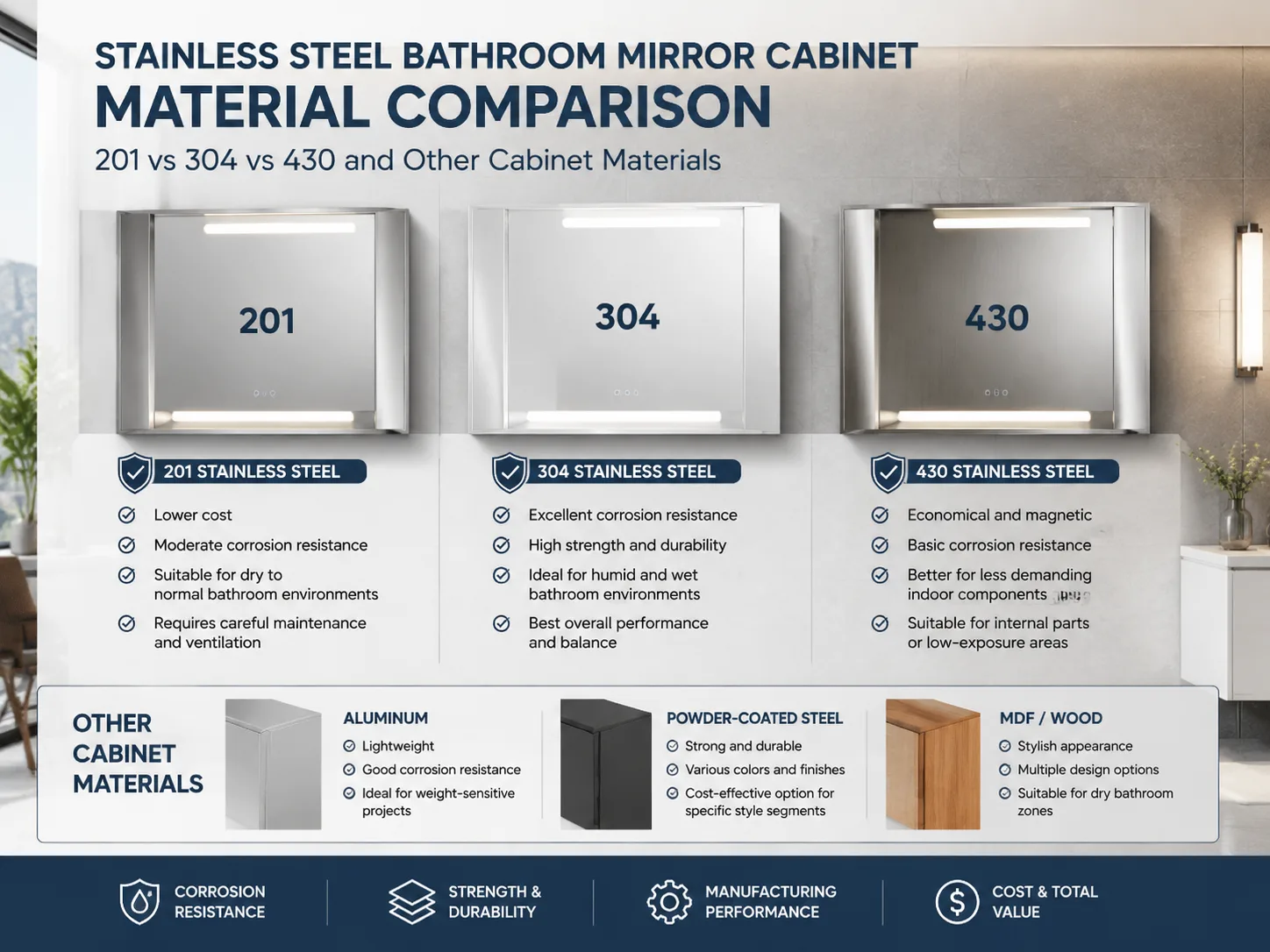
For most indoor residential, hotel and apartment bathrooms, 304 stainless steel provides the best balance of corrosion resistance, strength, fabrication performance and cost for a stainless steel bathroom mirror cabinet. Grade 201 can reduce cost but requires stricter control of surface finish, ventilation, cleaning and exposure conditions. Grade 430 is economical and magnetic, but it is generally better suited to less demanding indoor components than to premium wet-zone cabinet bodies.
1. Why Bathroom Mirror Cabinet Materials Selection Matters in a Bathroom Mirror Cabinet
A bathroom is a challenging environment for any cabinet, regardless of the bathroom mirror cabinet materials used. Steam can condense on cool metal surfaces. Water may remain around hinges, seams, shelves and lower edges. Toothpaste, soap, cosmetics and household cleaners can leave residues. In commercial projects, cleaning frequency may be much higher than in a private home. If the material and construction are poorly matched to the environment, the result may be staining, edge corrosion, coating failure, swelling, door misalignment or early hardware replacement, even in a stainless steel bathroom mirror cabinet with an unsuitable material grade.
The cabinet material influences several purchasing factors at the same time when selecting a stainless steel mirror cabinet or other cabinet types:
- Corrosion resistance in humid and splash-prone conditions.
- Structural rigidity, especially for wide doors and heavy mirrored panels.
- Cabinet weight and the load placed on wall fixings.
- Compatibility with bending, welding, riveting and concealed electrical compartments.
- Surface appearance, including brushed, polished, painted or fingerprint-resistant finishes.
- Maintenance requirements and sensitivity to cleaning products.
- Expected service life, warranty exposure and replacement cost.
- Suitability for residential, hospitality, healthcare, or public projects.
2. What Makes Stainless Steel Bathroom Mirror Cabinets Suitable?
Stainless steel is an iron-based alloy containing enough chromium to form a thin passive surface layer. This passive layer helps the metal resist corrosion, and it can reform when the surface has access to oxygen. However, stainless steel is corrosion-resistant rather than completely rust-proof. Chlorides, stagnant moisture, rough finishing, contamination from carbon steel tools, damaged weld areas and unsuitable cleaning chemicals can still cause staining or localized corrosion. Understanding these characteristics is essential when comparing different bathroom mirror cabinet materials for commercial and residential applications.
For a stainless steel mirror cabinet, stainless steel offers four major advantages:
- High strength in relatively thin sheet, which helps create a rigid cabinet shell.
- Good resistance to bathroom humidity when the correct grade and finish are used.
- A clean, modern surface that can be brushed, polished, coated or colored.
- Good recyclability and long service potential when the cabinet is properly designed and maintained.
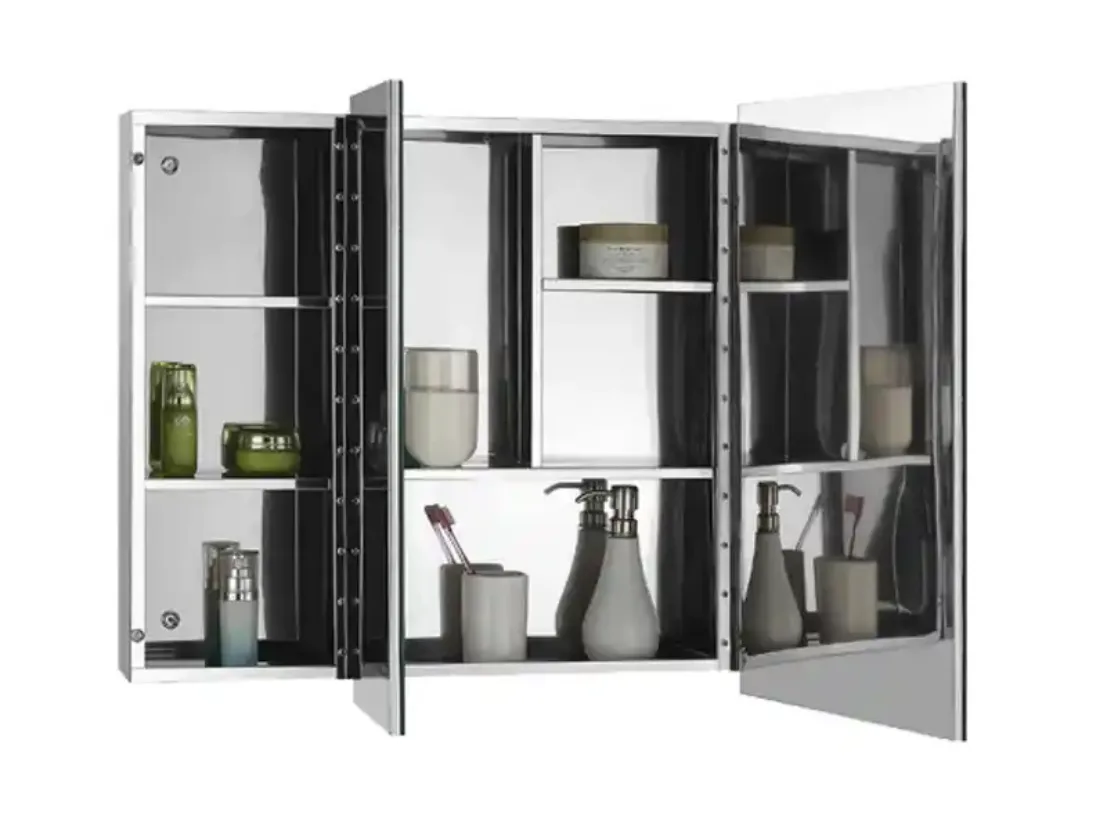
Stainless Steel Bathroom Cabinet with Mirror Bathroom Vanity Modern
3. Stainless Steel Grades Used in Bathroom Mirror Cabinets
The grade is the first major difference between stainless steel cabinet bodies. The following comparison describes common commercial choices, but buyers should remember that regional standards and supplier designations may vary.
Grade | General profile | Bathroom corrosion fit | Relative cost | Typical recommendation |
201 | Low-nickel austenitic stainless steel; strong and cost-sensitive | Acceptable for controlled indoor use, but less forgiving of persistent moisture than 304 | Low | Entry-level indoor products with clear maintenance and environment limits |
304 / 304L | Widely used 18/8-type austenitic stainless steel with good formability and weldability | Strong general-purpose choice for most indoor bathrooms | Medium | Preferred standard for mainstream and premium residential or project cabinets |
430 | Nickel-free ferritic stainless steel; magnetic and economical | Fair for mild indoor conditions; less suitable for premium wet-zone cabinet shells | Low to medium | Interior panels, decorative parts or cost-sensitive dry applications after validation |
3.1. Grade 201 Stainless Steel
Grade 201 is a low-nickel austenitic stainless steel in which manganese and nitrogen help achieve the required structure and mechanical properties. It can provide good strength and an attractive appearance at a lower material cost than 304. The purchasing risk is that “201 stainless steel” is sometimes treated as if it were automatically equivalent to 304 in a bathroom. It is not. In a dry, ventilated indoor environment, a properly finished 201 cabinet may perform acceptably. In a constantly damp room, it offers a smaller margin for error.
3.2. Grade 304 and 304L Stainless Steel
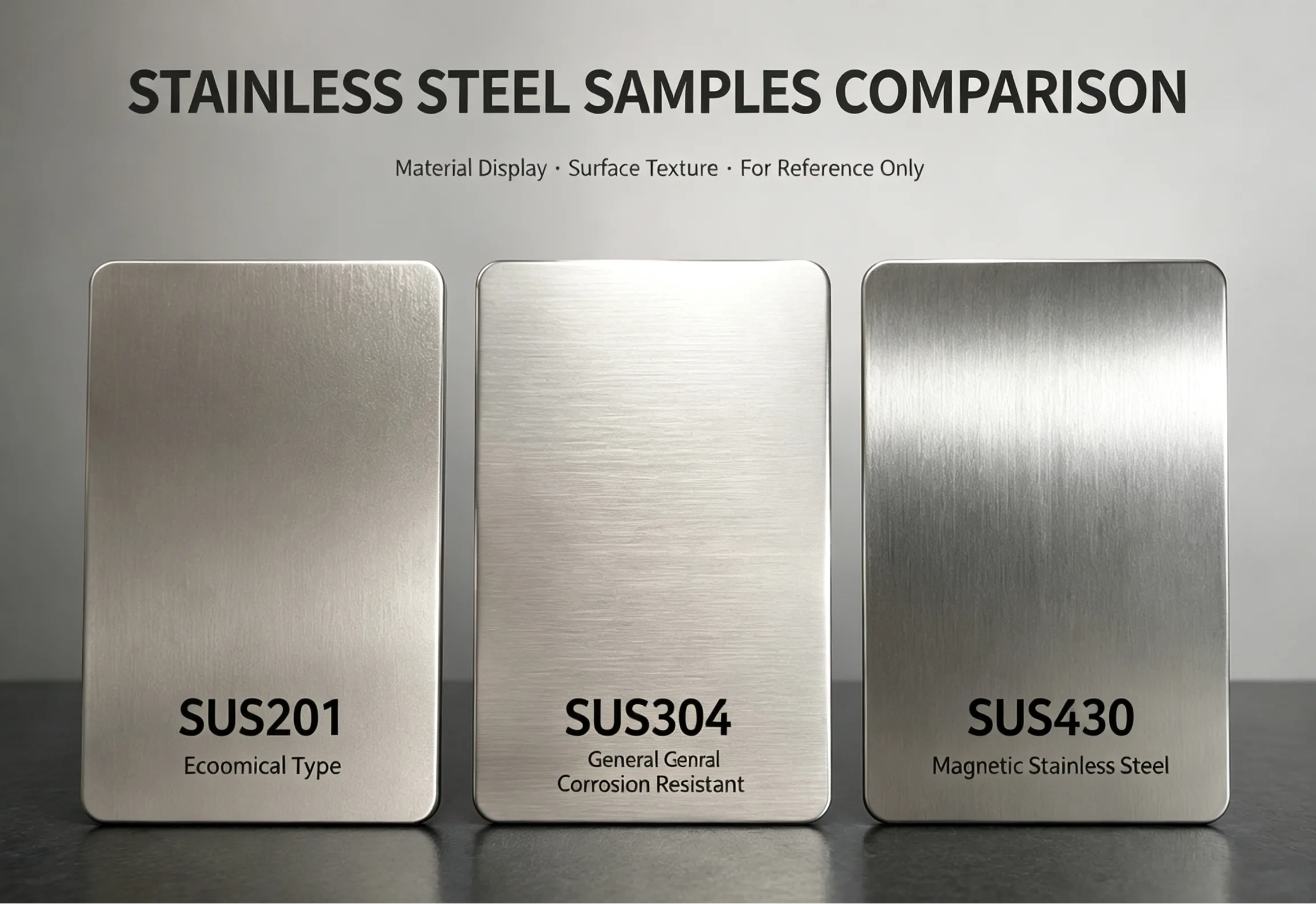
Grade 304 (often referred to as SUS304 globally) is the most common reference point for a stainless steel bathroom mirror cabinet. It is a general-purpose chromium-nickel austenitic grade with good corrosion resistance, formability and weldability. For most indoor bathrooms, 304 offers the best balance between performance and cost. A 304 label does not guarantee a good cabinet by itself. The steel must be correctly identified, protected from carbon-steel contamination, finished consistently and combined with suitable hardware.
3.3. Grade 430 Stainless Steel
Grade 430 is a ferritic stainless steel with no significant nickel addition. It is magnetic, cost-effective and suitable for many mild indoor applications. Industry guidance generally describes its corrosion resistance as fair rather than equivalent to premium austenitic grades in demanding conditions. It offers a perfect middle ground that does not rely on volatile global alloy pricing.
4. 201 vs 430 vs 304 Complete Comparison Matrices
To assist procurement teams in evaluating the precise trade-offs, we have organized the key specifications into two quick-reference matrices: Physical Properties and Commercial ROI.
Table A: Physical & Material Properties Matrix
Comparison Item | 201 Stainless Steel | 430 Stainless Steel | SUS304 Stainless Steel |
Surface Stability | Standard | High | Extremely High |
Humidity Performance | Well-Ventilated Zones | Standard Bathrooms | Steam & Wet Zones |
Magnetic Property | Non-Magnetic | Magnetic | Non-Magnetic |
Typical Thickness Options | 0.4mm – 0.6mm | 0.4mm – 0.8mm | 0.4mm – 1.0mm+ |
Structural Formability | High Rigidity | Moderate | Highly Formable & Tough |
Table B: Commercial ROI & Application Matrix
Comparison Item | 201 Stainless Steel | 430 Stainless Steel | SUS304 Stainless Steel |
Manufacturing Cost | Low | Medium | High |
Retail Market Fit | High-Volume Retailers | Big-Box Home Centers | Boutique & Premium Brands |
Commercial Hotels | Budget & Transit Lodging | Mid-Scale Accommodations | 4-Star to 5-Star Hospitality |
B2B ROI Profile | High initial margin | Balanced margin and durability | Maximum asset lifecycle |
5. Surface Finish Options for Stainless Steel Bathroom Mirror Cabinets
Surface finish affects the appearance, cleanability and corrosion behavior of a stainless steel mirror cabinet and is an important consideration when selecting bathroom mirror cabinet materials. Common options include:
- Brushed finish: practical, modern and effective at hiding small handling marks.
- Mirror-polished finish: visually striking but more sensitive to fingerprints and visible scratches.
- Bead-blasted or satin finish: low-glare appearance, requiring strict process control.
- PVD-colored stainless steel: decorative gold, bronze, or black tones for a premium stainless steel bathroom mirror cabinet.
- Fingerprint-resistant coating: useful for dark or polished surfaces
6. Why True Stainless Steel Bathroom Mirror Cabinets Can Still Develop Rust Stains
When a stainless steel bathroom mirror cabinet shows brown staining, the immediate assumption is often that the material is fake. Incorrect material is one possibility, but it is not the only cause. Common causes include:
- Fabrication Contamination: Carbon-steel contamination from shared grinding tools, worktables, or metal dust.
- Chemical Exposure: Chloride-containing cleaners left on the surface without rinsing.
- Trapped Moisture: Standing water in seams, horizontal ledges, or poorly drained lower edges.
- Hardware Corrosion: Low-grade fasteners or hinges corroding and staining the surrounding premium stainless steel shell.
- Untreated Welds: Weld heat tint or damaged passive surfaces that were not restored during production.
7. How B2B Buyers Can Verify Bathroom Mirror Cabinet Materials and Stainless Steel Material Claims
Because different bathroom mirror cabinet materials and stainless steel grades can look similar after polishing or brushing, professional buyers should not rely on a magnet test or visual inspection alone. Magnet behavior is influenced by alloy family and cold working, making it an incomplete identification method. A reliable procurement process for purchasing a stainless steel mirror cabinet should include:
- Documentation: Requesting a mill test certificate or material certificate for commercial orders.
- Testing: Using handheld XRF screening or an independent laboratory when grade verification is critical.
- Systematic Inspection: Checking sheet thickness at several points and inspecting hidden surfaces to confirm consistent grade usage.
- Hardware Verification: Validating the materials used for hinges, screws, mounting brackets, and accessories, not just the cabinet shell.
8. Recommended Material by Project Type
Project scenario | Recommended starting point | Why |
Standard residential bathroom | 304 stainless steel or aluminum | Balanced corrosion performance and long-term usability |
Hotel guest room | 304 stainless steel | Rigid, durable and suitable for repeated cleaning |
Apartment development | 304 stainless steel or quality powder-coated steel | Balances lifecycle value with project budget |
Entry-level retail range | 201 stainless steel or powder-coated steel | Lower cost |
Large wall-mounted cabinet | Aluminum or optimized stainless structure | Weight becomes a major installation factor |
9. Global Market Intelligence: 2026 Procurement Trends for Bathroom Mirror Cabinet Materials
The global bathroom mirror cabinet market is projected to exceed $1.02 billion in 2026. Bathroom mirror cabinet materials selection is strictly dictated by regional purchasing power, climate, and real estate compliance standards.
- North America (~35% Market Share): SUS304 dominates over 80% of commercial architectural specifications for stainless steel bathroom mirror cabinets. Because local labor costs for maintenance and fixture replacement are exorbitantly high, developers heavily favor extreme longevity to reduce Total Cost of Ownership (TCO).
- Southeast Asia & Emerging Markets (~8.9% CAGR): 201 stainless steel dominates high-volume hardware retail channels, while 430 stainless steel captures standard high-rise residential developments. SUS304 is reserved for luxury hospitality projects requiring a premium stainless steel mirror cabinet.
- Europe: SUS304 captures the high-end commercial sectors aligning with EU sustainability goals. However, 2026 sales data shows a significant surge in 430 adoption for standard residential renovations across continental Europe, reflecting growing demand for cost-effective bathroom mirror cabinet materials.
- The Middle East: For luxury hospitality mega-projects, SUS304 is non-negotiable for stainless steel bathroom mirror cabinets. For large-scale inland residential compounds, 430 is rapidly gaining market share to balance budgets.
10. Frequently Asked Questions
Is 201 stainless steel waterproof?
No metal grade should be described simply as waterproof. Grade 201 is corrosion-resistant stainless steel, but it is generally less forgiving than 304 in persistently damp or chloride-contaminated environments. Its suitability depends on ventilation, finish, design and maintenance.
Which is better for a mirror cabinet: stainless steel or aluminum?
Stainless steel is usually heavier and more rigid, with a solid premium feel. Aluminum is much lighter and supports extrusion-based construction and anodized finishes. The better choice depends on cabinet size, wall loading, appearance, price and installation environment.
What stainless steel grade is best near the sea?
Grade 316 is usually the first common upgrade considered for coastal or chloride-exposed projects. The exact selection should also consider distance from the coast, ventilation, surface washing, finish, crevices and maintenance frequency.
Is thicker stainless steel always better?
Not automatically. Thickness improves stiffness, but cabinet geometry, folded edges, reinforcement, door weight and mounting design also matter. A well-engineered thinner structure can outperform a poorly designed thicker one.
Which stainless steel is best for bathroom mirror cabinets?
SUS304 stainless steel is the best overall choice for most bathroom mirror cabinets due to its balance of corrosion resistance, durability, fabrication performance, and cost. SUS201 and SUS430 can be suitable for specific budget or indoor applications.
Does stainless steel rust in bathrooms?
Stainless steel does not easily rust, but it is not completely rust-proof. Poor finishes, chemical exposure, trapped moisture, carbon-steel contamination, or unsuitable grades can cause rust stains.
Is SUS304 worth the higher price?
Yes, for hotels, apartments, and premium residential projects. SUS304 offers better corrosion resistance, longer service life, and lower maintenance risk, making it a better long-term investment.
What thickness should a mirror cabinet use?
Common stainless steel cabinet thickness ranges from 0.4mm to 1.0mm+. The ideal thickness depends on cabinet size, door weight, structure design, and installation requirements.
How long does stainless steel last?
A well-designed stainless steel mirror cabinet can last 10–20+ years with proper maintenance. Service life depends on material grade, environment, surface treatment, and manufacturing quality.
Can stainless steel cabinets be customized?
Yes. Stainless steel mirror cabinets can be customized in size, thickness, finish, storage layout, lighting functions, hardware, and OEM branding to meet different market requirements.
Are stainless steel cabinets recyclable?
Yes. Stainless steel is highly recyclable and can be recovered and reused without significant loss of performance, making it a sustainable material choice.
11. OEM Factory Insights: How We Select Stainless Steel Materials for Mirror Cabinets
With 27 years of OEM/ODM manufacturing experience, we understand that choosing stainless steel for bathroom mirror cabinets is not only about selecting a material grade. The final performance depends on the combination of material, structure, fabrication process and quality control.
In our projects, we do not recommend one stainless steel grade for every customer. Instead, we evaluate the application environment, target market, budget and expected service life before confirming the specification.
For premium hotels, apartments and commercial projects, SUS304 is usually preferred for its balance of corrosion resistance, durability and long-term value. For cost-sensitive markets, SUS201 or SUS430 can also be suitable when the design, finishing and usage conditions are properly controlled.
During OEM production, we focus on several key quality points:
- Verifying stainless steel grade and material consistency
- Controlling sheet thickness and structural strength
- Ensuring precise cutting, bending, welding and surface finishing
- Inspecting cabinet assembly, hardware performance and electrical functions before shipment
Our global OEM customers also have different priorities. North American buyers often focus on durability, certifications and installation reliability, while European and hospitality customers usually emphasize sustainability, design quality and long-term performance.
At Aosmay, we provide customized stainless steel bathroom mirror cabinet solutions using SUS201, SUS430 and SUS304 materials. Our goal is not to promote the most expensive material, but to help customers select the most suitable solution based on their market positioning and project requirements.
12. Conclusion & OEM Manufacturing Options
Sourcing the right stainless steel mirror cabinet is not about finding a universally perfect material—it is about strategic alignment. As demonstrated by 2026 regional market data, selecting between 201, 430, and 304 requires balancing project environments, local compliance, and target budgets. Most importantly, buyers should evaluate the complete cabinet system: material grade, thickness, weld treatment, seams, hardware, electrical layout, mounting and quality-control evidence.
Discuss your stainless steel mirror cabinet project
Aosmay possesses more than twenty years of practical experience with online retail distribution channels and Amazon. We actively support the fabrication of 201, 430, and SUS304 stainless steel chassis, allowing distributors, retailers, and developers to select the exact material that matches their market positioning and ROI goals. Beyond raw material selection, our OEM/ODM facilities offer deep customization depth for commercial bulk orders.
We offer design services to help global brands build scalable, profitable product lines based on actual market data rather than simply pushing a single material standard. Share your target market, dimensions, preferred stainless steel grade, finish, lighting functions, and storage layout so the cabinet structure and material specification can be reviewed as one complete solution.
Technical Reference Notes for the Editor
The following sources were used to verify general material statements. This section may be retained as an editorial reference or removed before publishing the article on the website.
- Outokumpu – Core 304/4301: general characteristics of Type 304 / EN 1.4301
- Outokumpu – Austenitic stainless steel grades and molybdenum-bearing Cr-Ni-Mo grades
- British Stainless Steel Association – Grade 430 overview
- Australian Stainless Steel Development Association – Preventing coastal corrosion and tea staining
- Australian Stainless Steel Development Association – Cleaning indoor stainless steel
- worldstainless – Stainless Steel Grade Datasheets
- European Aluminium – Aluminium material properties and natural oxide layer