
Quick Answer
A golden sample is the final approved product sample used as a reference for mass production and quality inspection. In OEM bathroom mirror production, it helps buyers and manufacturers agree on the expected appearance, dimensions, materials, functions, and finish before bulk manufacturing begins.
For wholesalers, bathroom accessory retailers, contractors, and hotel project buyers, approving a golden sample can reduce misunderstandings, support consistent product quality, and make customized bathroom mirror orders easier to manage. Whether developing standard mirrors, LED bathroom mirrors, or mirror cabinets, buyers should use an approved sample together with technical drawings, specifications, tolerances, and inspection records.
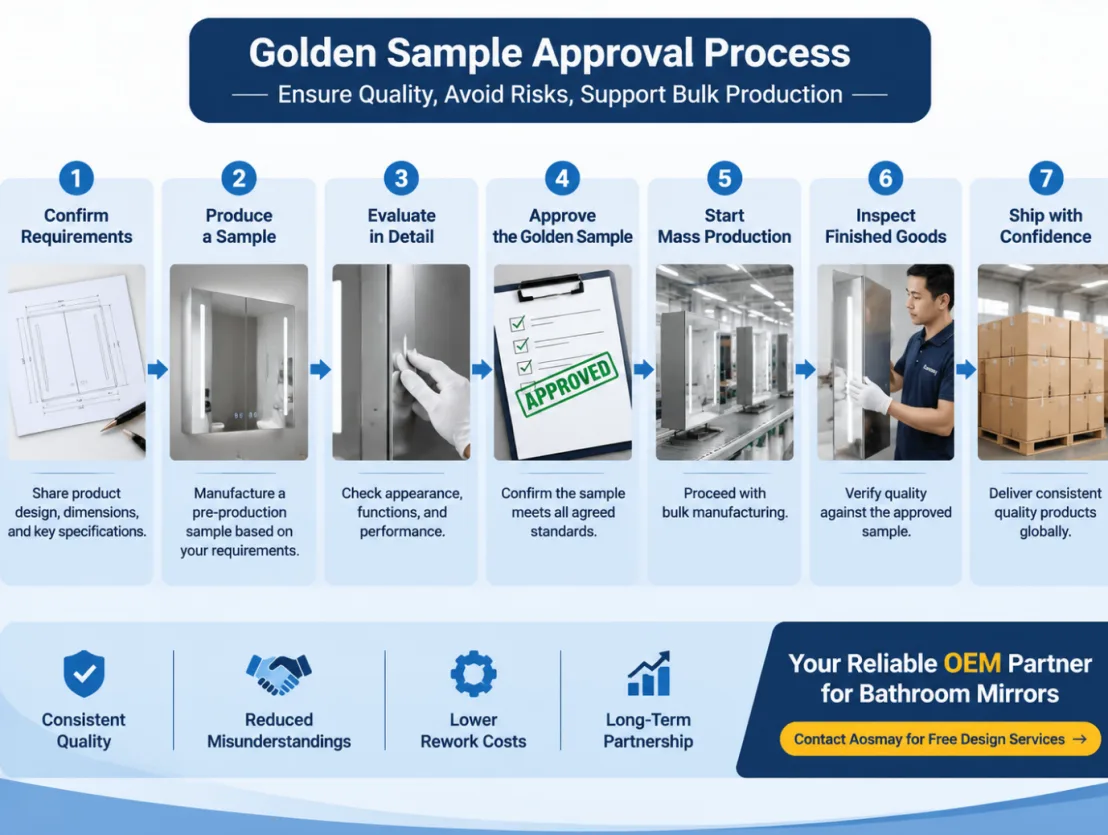
1. What Is a Golden Sample in OEM Manufacturing?
A golden sample, also called an approved sample or reference sample, is a physical product formally accepted by the buyer and manufacturer as the agreed production reference.
Unlike an early prototype, a golden sample should represent the approved product configuration as closely as practical, using the intended production materials, components, finishes, and assembly methods.
For a custom bathroom mirror, LED bathroom mirror, or mirror cabinet, the approved sample may establish the reference for:
- Overall dimensions, shape, and mirror proportions.
- Mirror glass quality, thickness, clarity, and edge treatment.
- Frame material, surface finish, color, and coating, where applicable.
- LED lighting color temperature, brightness, and light distribution, where specified.
- Touch controls, touchless sensors, anti-fog functions, and other ordered features.
- Mounting structure, electrical components, and accessories.
- Labels, branding details, and protective packaging.
For mirror cabinets, additional checks may include cabinet materials, door alignment, hinges, shelves, and internal storage layout.
2. Why Is a Golden Sample Important for Bathroom Mirror Production?
2.1. It Reduces Misunderstandings Before Mass Production
Terms such as “matte black,” “warm white,” or “large storage capacity” can be interpreted differently by different teams.
A physical reference, supported by written specifications, gives the buyer and factory a common basis for reviewing the product before approving a bulk order.
For customized bathroom mirrors, this is particularly useful when the design involves special dimensions, mirror shapes, frame finishes, LED lighting configurations, or additional functions. For mirror cabinet orders, internal storage requirements and cabinet structures should also be clearly confirmed before production.
2.2. It Helps Control Product Consistency
During OEM bathroom mirror production, different production batches may be affected by material variation, component substitutions, finishing conditions, or assembly adjustments.
Comparing production units against the approved reference can help identify visible differences in mirror dimensions, glass appearance, edge finishing, frame color, LED lighting, and functional components. However, appearance checks alone are insufficient: dimensions, electrical performance, durability, and other critical requirements must be verified using appropriate inspection or testing methods.
2.3. It Helps Prevent Costly Rework
Discovering an incorrect finish, cabinet dimension, lighting configuration, or accessory arrangement after hundreds of units have been assembled can lead to rework, delays, and additional inspection costs.
Golden sample approval creates a checkpoint before bulk production is released. It does not eliminate all quality risks, but it gives both parties an opportunity to resolve important design questions earlier.
2.4. It Supports Repeat Orders and Private-Label Projects
For importers and distributors, product consistency matters beyond the first shipment. A documented reference can help the manufacturer reproduce the agreed configuration for future orders and clarify which version was approved.
If materials, components, suppliers, drawings, or production processes change, the buyer and manufacturer should assess the impact and determine whether a revised sample or renewed approval is necessary.
3. Golden Sample vs. Prototype vs. Pre-Production Sample
These terms are related, but they serve different purposes. Terminology may vary between manufacturers, so buyers should define each stage in their purchase agreement.
Sample Type | Main Purpose | What Buyers Should Check |
Prototype | Evaluates the initial concept | Design, layout, feasibility, and basic functions |
Pre-production sample | Verifies the intended production configuration | Materials, components, dimensions, finish, functions, and packaging |
Golden sample | Establishes the formally approved reference | All agreed acceptance criteria and documented deviations |
Production inspection sample | Checks actual mass-produced units | Conformity with the approved reference and written specifications |
A pre-production sample may become the golden sample once it has been formally approved and identified. The important point is not the label, but the documented approval process.
4. How to Approve a Golden Sample for OEM Bathroom Mirrors: 7 Essential Checks
Before releasing a bulk order, buyers should review the following items.
- Dimensions and technical drawings
Confirm the overall dimensions, mirror shape, glass thickness, edge details, mounting positions, and installation clearances. For framed or LED bathroom mirrors, also verify frame dimensions and LED placement. Link the approved sample to the correct drawing revision.
- Materials and surface finish
Confirm the specified mirror glass type, thickness, frame material, surface treatment, color, and finish. For framed bathroom mirrors, verify the frame material and coating against the agreed specifications. For frameless mirrors, pay particular attention to glass quality, edge polishing, and overall appearance rather than relying on visual impressions alone.
- Mirror and lighting performance
Check the mirror’s reflection clarity, surface appearance, and edge quality. For LED bathroom mirrors, inspect the specified color temperature, brightness levels, lighting uniformity, and light distribution. Confirm that the mirror performs according to the approved design and technical requirements.

- Functions and accessories
Test the functions included in the order, such as touch controls, touchless sensors, anti-fog systems, or shaver sockets. Confirm that the correct accessories and components are included.
- Frame, Mounting, and Component Assembly
For framed or LED bathroom mirrors, check frame alignment, mounting brackets, electrical connections, and the installation of LED strips and other components. Ensure that all parts are securely assembled and that the finished product matches the approved design. For mirror cabinets, additional checks should include door alignment, hinge operation, shelf installation, and internal storage space.
- Packaging and transportation protection
Review carton construction, protective foam, corner protection, edge cushioning, labels, and packing instructions. For fragile bathroom mirrors, verify that the packaging provides adequate protection against impact, vibration, and transportation damage. If required, agree on suitable transportation testing. Buyers can refer to ISTA for packaging performance testing resources.
- Approval records and change control
Record the sample ID, product model, drawing revision, approval date, authorized approvers, and any accepted deviations. Keep matching controlled references or a documented record of the approved configuration.
Do not rely on an informal message such as “sample looks good” when important specifications remain unresolved.
6. What Happens If Mass Production Does Not Match the Golden Sample?
If a production unit differs from the approved reference, first identify the specific discrepancy and compare it with the written specifications and acceptance criteria.
For example, differences in mirror glass appearance, edge polishing, frame color, or LED lighting may require visual comparison under agreed conditions, while incorrect dimensions or mounting positions require measurement against the approved drawing and tolerances. For mirror cabinets, differences in cabinet finish, door alignment, or internal configuration should also be checked against the approved reference.
The buyer and manufacturer should document the finding, determine whether it is acceptable, and agree on corrective action before the affected goods are released. If a change is approved, update the relevant records so that production and inspection teams use the same revision.
A golden sample is a quality reference, not an automatic guarantee that every unit will conform. Effective quality control also requires clear specifications, appropriate inspections, and suitable testing.
7. B2B Golden Sample Approval Checklist
Before confirming mass production, check that you have:
- Approved the final design and product configuration.
- Confirmed mirror dimensions, glass specifications, materials, finishes, and tolerances.Verified mirror reflection quality, edge finishing, and LED lighting performance, where applicable.
- Tested the functions included in the order.
- Reviewed the correct technical drawings and revision.
- Confirmed accessories, labels, and packaging requirements.
- Recorded sample identification and written approval.
- Agreed on inspection criteria and handling of deviations.
- Established a process for approving significant changes.
For broader quality management context, buyers can consult the ISO 9001 quality management systems standard. The applicable requirements should be confirmed for the particular project; sample approval by itself does not establish ISO certification or product compliance.
8. Frequently Asked Questions
Is a golden sample mandatory for every OEM bathroom mirror order?
Not necessarily. The need depends on product complexity, customization, order size, contractual requirements, and quality risks.For customized bathroom mirrors, LED mirrors, mirror cabinets, or repeat bulk orders, a formally approved reference is often a practical safeguard.
Who approves the golden sample?
Typically, the buyer or an authorized representative approves the sample, while the manufacturer records and controls the approved version. Both parties should agree on who can authorize changes.
Should the golden sample be made before mass production?
Yes, when the parties use it as the production approval reference. Key specifications and any unresolved issues should be settled before bulk manufacturing is released.
Does a golden sample replace product testing?
No. It supports visual and configuration checks but cannot replace applicable electrical safety, performance, durability, or other required tests and certifications.
What should buyers send a manufacturer before requesting a sample?
Provide the product dimensions, drawings or reference images, cabinet material, mirror specifications, lighting and control requirements, mounting method, target market, and any required certifications. The more complete the brief, the easier it is to review feasibility and reduce unnecessary revisions.
9. Conclusion: Approve the Reference Before You Approve the Bulk Order
A golden sample gives buyers and manufacturers a shared reference for customized bathroom mirror production. In OEM bathroom mirror production, approving the final sample before mass manufacturing helps clarify product appearance, dimensions, materials, lighting functions, and quality expectations.
When linked to clear specifications, technical drawings, inspection criteria, and change control, a golden sample can help reduce avoidable misunderstandings and support more consistent bulk orders.
For wholesalers, retailers, contractors, and hotel project buyers, the best approach is to approve the product configuration before mass production and verify finished goods against both the approved sample and the written requirements.
Aosmay provides OEM/ODM customization for bathroom mirrors and fully assembled LED mirror cabinets. If you are developing a custom product or preparing a bulk order, contact our team to discuss your specifications and free design services.
Explore our LED mirror cabinets, LED mirrors, or contact Aosmay to discuss your project.