
Quick Answer (Aosmay’s initial planning guideline — not an industry standard):
Plan for 3–5% of installed bathroom mirror units as complete spares (about 4–7 mirrors per 100 keys), plus a separate kit of replacement LED drivers, sensors, defogger pads and mounting hardware at 8–15% of those components. Treat the percentage as a starting point adjusted by model count, custom finishes, ocean-route risk and phased handover — not a universal rule. Order spares with the main production run; a later overseas reorder of a custom mirror typically runs 8–16 weeks before freight.
This guideline covers both lighted bathroom mirrors and LED mirror cabinets, as they share similar procurement, packaging, lead-time and spare-part logic for hotel FF&E.
Why Spare Bathroom Mirrors are a Procurement Decision, not an Afterthought
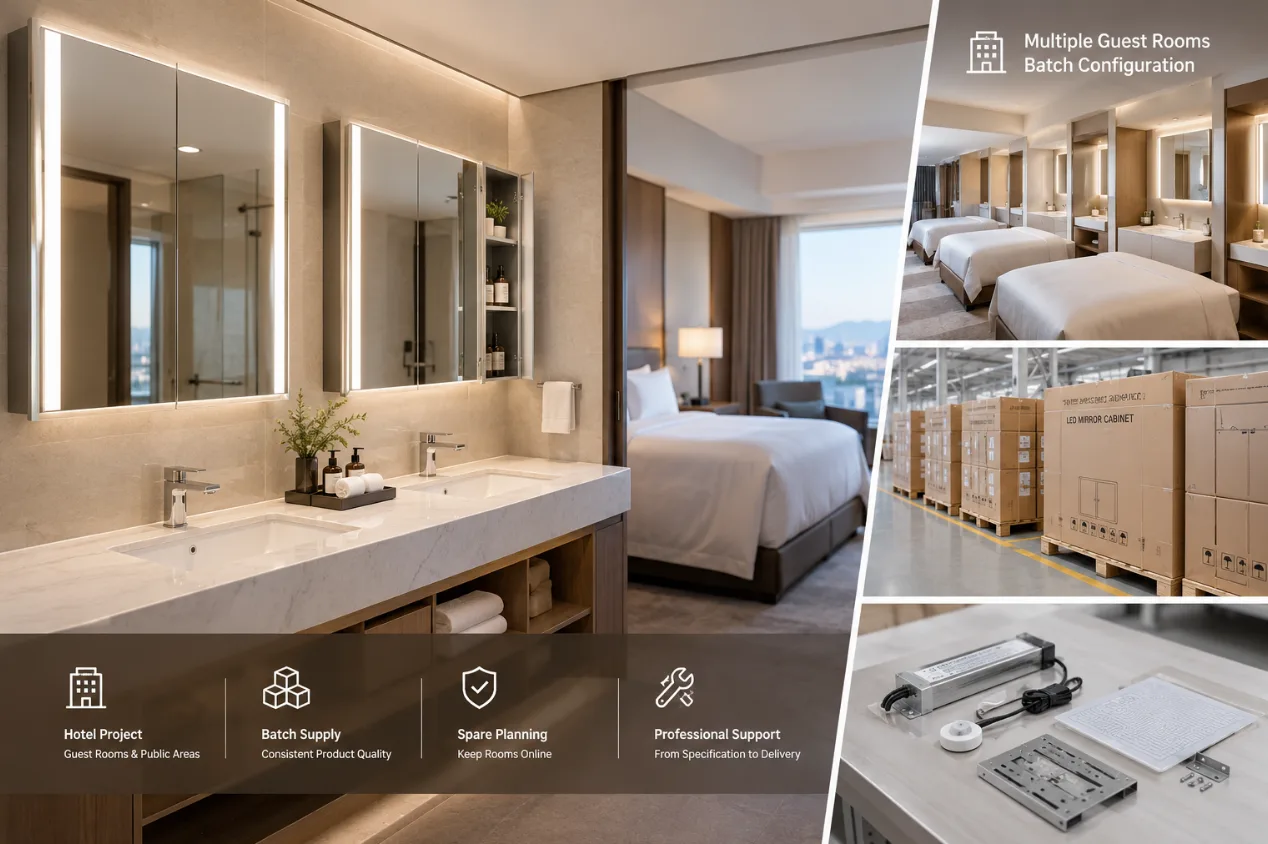
A bathroom mirror in a hotel is an installed asset, not a décor prop. It sits in the most corrosive room of the building, carries an LED system that can fail independently of the glass, and — once a property opens — a single out-of-service room is lost revenue every night it stays dark or fogged. Most mirror “quality problems” in bulk hospitality orders are actually packaging and planning failures: corners crush, edges chip, and drivers fail on install. Spare planning exists to absorb exactly these events without a brand-inconsistent replacement or a multi-month reorder.
The commercial case is simple. Reordering a custom-sized or special-finish bathroom mirror from an overseas manufacturer may involve additional production time, quality checks and international transportation. During this period, a room affected by a damaged or non-functioning mirror may face operational disruption and potential revenue loss. Ordering spare units with the main production run can help reduce the risk of delays, maintain product consistency and avoid a separate replenishment shipment.
The 2026 Market Context (Estimates, not a Verdict on your Order Size)
Hotel construction, renovation and refurbishment projects create ongoing demand for bathroom mirrors and mirror cabinets across guest rooms, suites and shared facilities. For procurement teams, however, the number of spare units should be based on the project’s actual specifications, installation quantity, transportation arrangements and replacement lead times rather than overall hospitality market growth alone.
- Context, not a verdict: a growing lodging pipeline means more mirror specifications are being written — but market size alone does not tell you how many spares to order. That depends on your project’s model count, route and lead time, covered below. These figures are third-party research estimates, not official statistics.
Bathroom mirror replacement schedules vary according to product condition, maintenance history, renovation plans and hotel brand requirements. For projects involving multiple guest rooms, suites and public facilities, planning spare units in advance can help maintain consistent product specifications and simplify future maintenance.
The Spare-quantity Method (Aosmay’s Initial Planning Guideline)
The 3–5% complete-spare rate is Aosmay’s initial planning guideline, intended as a starting point for project-specific procurement discussions rather than a verified industry standard. The appropriate quantity should be adjusted according to the number of installed mirrors, model variations, customization requirements, transportation risks and replacement lead times. The component ratio is also a preliminary reference and should be recalculated based on the actual quantities of LED drivers, sensors, defogger pads and mounting hardware required for the project.
Use this formula, then validate against the decision matrix in Section 5:
Complete spare mirrors = CEILING( Total installed mirror units × Base rate )
where the base rate starts at 3–5% and is adjusted up or down by the factors listed later. “Installed units” means guestroom mirrors (roughly 1 per key) plus public-area and back-of-house restroom mirrors. The table below is recomputed strictly from the formula.
Property size (rooms) | Approx. installed bathroom mirrors* | Complete spares (3–5%, per formula) | Replacement components (drivers / sensors / hardware) |
50 keys | ~55–65 | 2–4 units | 8–10% of drivers/sensors |
100 keys | ~110–130 | 4–7 units | 8–10% of drivers/sensors |
200 keys | ~220–260 | 7–13 units | 8–12% of drivers/sensors |
300+ keys | ~330–400 | 10–20 units | 10–15% of drivers/sensors |
*Installed count varies with suite mix, public restrooms and back-of-house; confirm against the FF&E schedule, not the room count alone. Figures are planning ranges from the formula, not guarantees — final quantities depend on model count, route risk and reorder lead time.
Why two separate ratios?
Glass breakage in transit is rare with engineered packaging, so complete mirrors are a thin reserve for shipping loss and on-site accidents. The higher-frequency failures are electronic: LED drivers, touch sensors, defogger pads and mounting hardware. ArcQuay’s commercial mirror procurement guide notes the spare plan “may include mounting hardware, approved drivers, sensors, control modules or complete mirrors” — and that each spare should be labeled to the same model and revision as the installed product. Stocking components at 8–15% is what actually keeps rooms online between renovations.
Material, Packaging and Certification Factors That Affect Spare Planning
The number of spare bathroom mirrors a hotel project needs depends not only on the spare percentage but also on product specifications, packaging protection, installation conditions and the availability of replacement parts.
- Packaging protection. Bathroom mirrors are vulnerable to edge impacts, corner damage and vibration during transportation. Individual protective wrapping, reinforced corner protection, suitable cushioning and strong outer cartons can help reduce the risk of transit damage. For large-volume hotel orders, buyers should review packaging specifications and relevant drop-test reports before confirming the order. ISTA 3Ais a distribution-package test procedure, so any claim of compliance should be supported by the applicable test documentation.
- Mirror quality and edge protection. Moisture exposure can contribute to mirror-edge deterioration over time. Buyers should evaluate the mirror’s glass specifications, edge-sealing process and suitability for humid bathroom environments. Copper-free silver mirrors may be considered as one option, but actual durability depends on the complete manufacturing process and should be assessed using relevant product test data.
- IP protection and electrical components. For LED bathroom mirrors and mirror cabinets, check the IP rating applicable to each relevant component and the conditions under which it was tested. IP44 or IP65 should not be treated as a blanket rating for the entire product unless the applicable test documentation supports that scope. Confirm the suitability of the LED driver, sensor, defogger and electrical connections for the intended installation environment.
- Cabinet materials and surface finishes. Anodized aluminum, powder-coated steel and stainless steel offer different material and finish options. Their suitability depends on the alloy, surface treatment, bathroom environment and maintenance conditions. For projects exposed to high humidity or coastal air, request relevant corrosion-resistance or salt-spray test reports instead of relying on the material name alone.
- Certification and configuration control. For European projects, buyers should review the applicable [CE marking requirements] and verify that the product documentation matches the intended configuration.Buyers should verify that the applicable UL, CE or UKCA documentation covers the exact model, electrical components and configuration being purchased. Changes to size, driver, plug or other critical components may require additional verification. Confirm certification scope with the manufacturer before production.
Procurement takeaway: Before finalizing the spare quantity, review the product specification, packaging method, test documentation, installation environment and replacement-part availability together. A well-planned spare strategy should reflect the actual risks of the project rather than rely on a fixed percentage alone.
Decision Matrix: When to Raise or Lower the Spare %
Factor | Effect on spare quantity | Adjust toward |
Number of distinct mirror models | More models = more unique failure points and less shared stock | Higher (each model needs its own spares) |
Custom / special finish | Cannot be re-ordered fast; dye-lot and extension risk | Higher (hold at upper end) |
Long ocean route / high handling | Greater transit and route risk | Higher complete-spare rate |
Phased handover | Need spares available per phase, not just at end | Higher, split by phase |
Single standardized model + ISTA 3A packaging | Lower failure and damage; shared stock | Lower (hold at base) |
Local stock / fast reorder available | Shorter replenishment window | Lower |
Cross-room standardization on one mirror model is the single biggest cost reducer in a spares strategy: your storage footprint shrinks and maintenance can fix any room from a single kit shelf. When evaluating LED mirror cabinets, confirm which models and finishes can be standardized across room types.
Illustrative Scenario: a 220-key Resort Rollout
The following is an illustrative scenario used to show the method — not a claim about a specific Aosmay customer project.
A 220-key resort in Southeast Asia specifies a single LED mirror-cabinet model across guestrooms, with a few custom-sized units for suites. The procurement team orders 5% complete spares (12 units) plus 10% of drivers and sensors as a component kit, all shipped in the final container. Six weeks after opening, a forklift accident and two driver failures take three rooms offline. Because spares are already on-site and labeled to the exact model revision, all three rooms are restored within 48 hours — avoiding a 14-week overseas reorder window. The spare investment is a fraction of one room-night’s annual revenue.
This mirrors the pattern from our fully assembled vs. knock-down mirror cabinet discussion: the value is not “the factory supplies hotels,” but that a buyer can see we understand their risk — model count, route, lead time and brand consistency.
FAQ — Hotel Spare Bathroom Mirror Questions Buyers Search
Q: How many spare bathroom mirrors should a hotel order per 100 rooms?
A: As a planning guideline, about 4–7 complete mirrors (3–5% of installed units) for a 100-key property, plus a component kit of drivers/sensors/hardware at roughly 8–10%. Adjust for model count and route risk.
Q: Should we order complete spare mirrors or just spare parts?
A: Both, in different ratios. Complete mirrors cover transit loss and accidents; components (drivers, sensors, defogger pads, hardware) cover the more frequent electronic failures at 8–15%.
Q: What is attic stock in hotel FF&E — does it include mirrors?
A: Attic stock is the reserve held to repair/replace items after opening; industry practice is 2–5% extra at the original order. For mirrors it typically includes matched drivers and a small number of complete units for an exact match years later.
Q: How long does it take to reorder a custom hotel bathroom mirror?
A: Typically 8–16 weeks for an exact overseas match before freight — which is why spares ship with the main order.
Q: Do hotel brand standards require spare mirrors?
A: It varies by flag; many treat a spare/attic-stock deliverable as expected at handover. Confirm against the approved brand standard and shop drawings.
Turn this Into a Project Inquiry — What to Send Aosmay
Request a project-specific spare-parts and packaging proposal
Aosmay has manufactured bathroom mirrors since 1999 as an OEM/ODM factory in Foshan, supplying commercial LED mirror cabinets to hotels, developers and B2B brands worldwide. To return a concrete spare-quantity and packaging proposal, share:
- Room count and estimated purchase volume (guestrooms + public/restroom mirrors).
- Mirror or cabinet models and customization (size, finish, lighting, socket type).
- Complete-spare and component needs you want us to plan for.
- Packaging method and target-market certifications (UL/CE/UKCA, IP rating per part).
- Delivery timing and phased-shipment plan.
We do not promise a fixed spare percentage or a confirmed lead time without reviewing your configuration — the proposal is built from your actual project, not a template. Start via our contact page, or read our LED bathroom mirror cabinet IP rating guide for the technical basis behind the ratings above.