
When architects and procurement teams specify bathroom fixtures for multi-family apartments, luxury hotels, or commercial spas, they meticulously evaluate the chassis material, the LED color temperature, and the glass clarity. However, one of the most critical structural components is frequently overlooked until a post-handover warranty claim arises: the medicine cabinet hinges.
The door of a modern illuminated mirror cabinet is an exceptionally heavy piece of engineering. It consists of 5mm copper-free glass, integrated heating defoggers, LED strips, and a metallic frame. If the hinge system is improperly specified, the dynamic weight of this door will inevitably lead to sagging, misalignment, and eventual mechanical failure.
Drawing from decades of OEM/ODM manufacturing excellence, this engineering guide deconstructs the mechanics of heavy-duty mirror doors, analyzes the essential medicine cabinet hinges types, and reveals how Aosmay’s material-specific hardware pairings ensure flawless commercial performance.
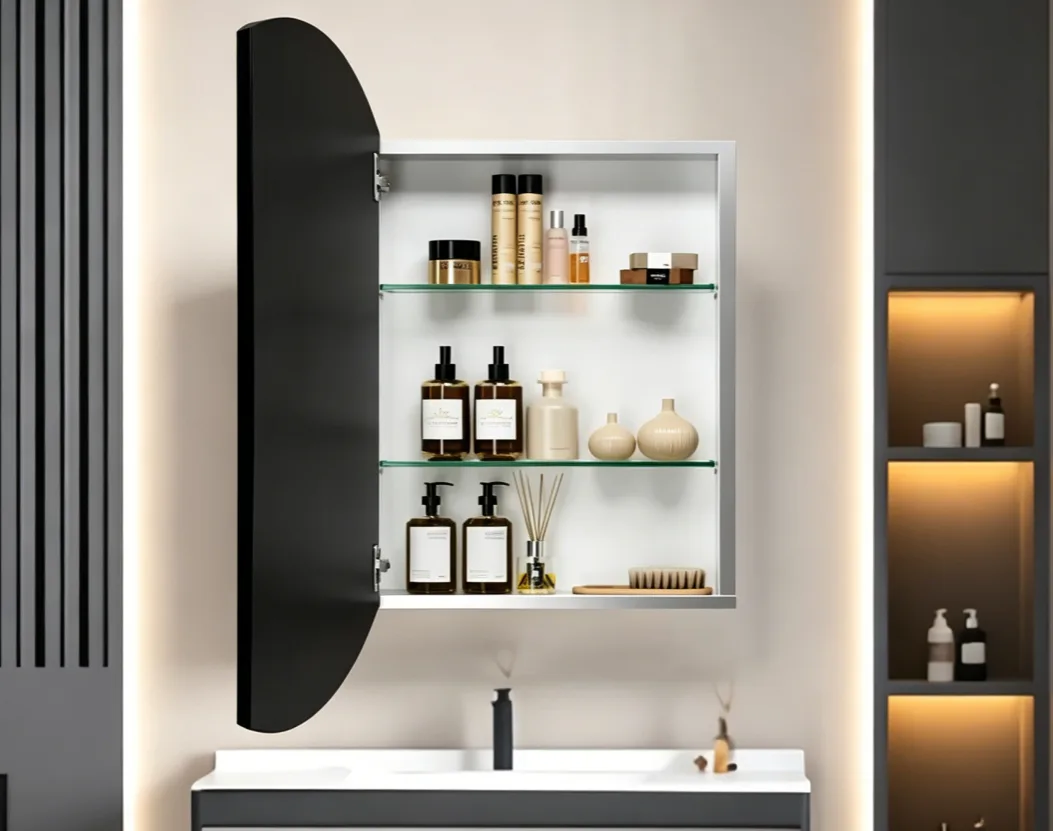
1. The Physics of the Mirror Door: Why Hinges Dictate Project ROI
To understand why hinges are a matter of commercial liability, we must examine the physics of a wall-mounted storage fixture.
Unlike a standard wooden kitchen cabinet door, a bathroom mirror cabinet door carries significant dense weight. Every time a hotel guest or apartment tenant opens the cabinet, they exert dynamic kinetic force.
- The Shearing Force: When the heavy mirrored door is fully extended at a 90-degree or 110-degree angle, the entire weight of the glass pulls downward, creating a massive shearing force on the hinge connection points.
- The Liability of Weak Hardware: Retail-grade hinges made from cheap zinc alloys will warp under this continuous torque. Within 12 to 18 months of commercial use, the doors will begin to sag, scrape against the bottom chassis, or fail to close entirely. For a property developer, sending maintenance teams to re-align or replace failing doors across a 500-unit building destroys the project’s long-term Return on Investment (ROI).
Selecting commercial-grade hardware is the ultimate insurance policy against these operational failures.
2. Analyzing the Core Medicine Cabinet Hinges Types
In commercial bathroom architecture, not all hinges are created equal. Depending on the size, weight, and structural design of the mirror cabinet, engineers primarily utilize two distinct medicine cabinet hinges types. Understanding the mechanical advantages of each is vital for accurate B2B procurement.
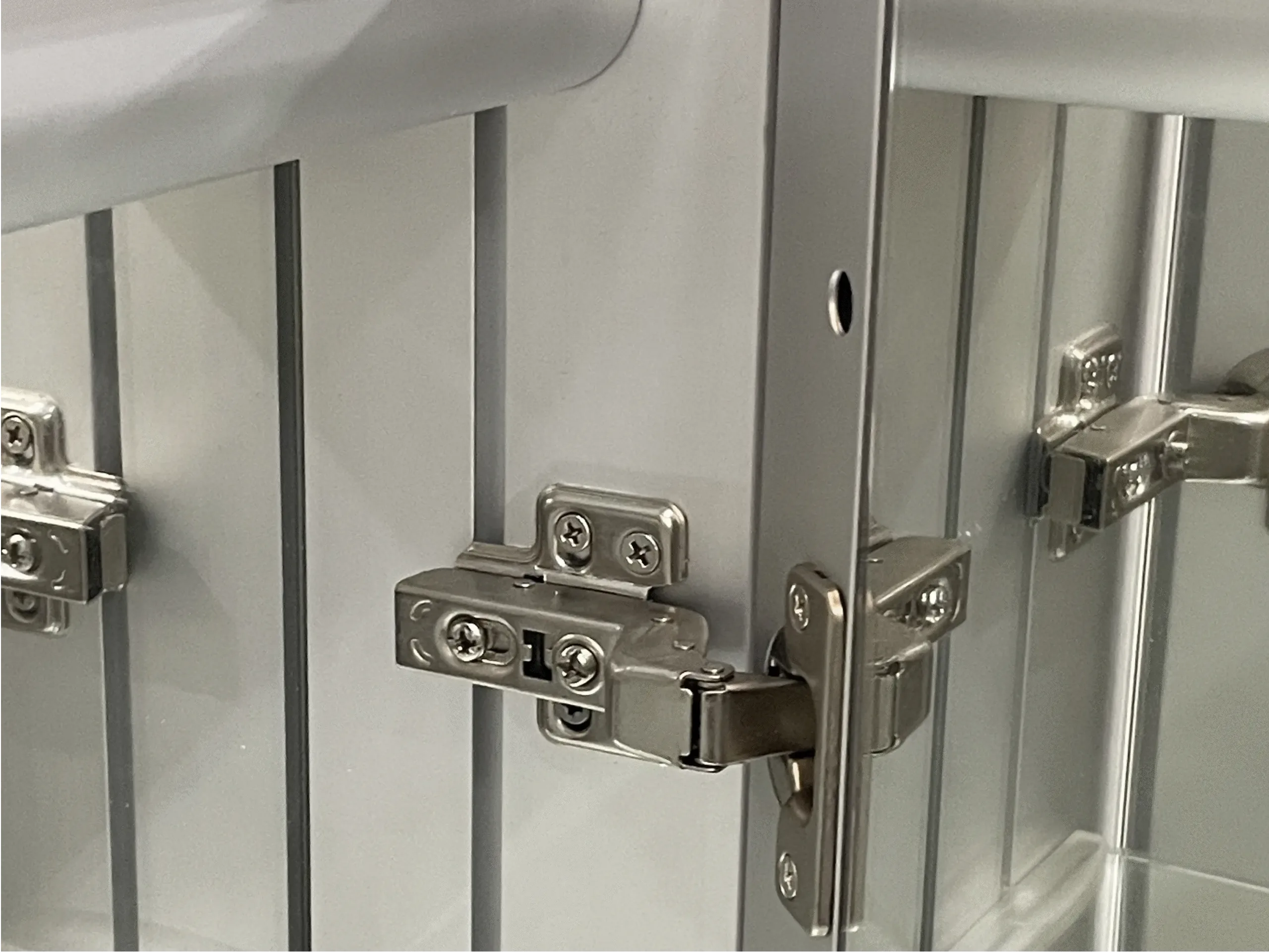
2.1. Standard Concealed Hydraulic Hinges (Soft-Close)
Commonly referred to as “European hinges,” these are the industry standard for modern, minimalist cabinetry. They are mounted on the interior side wall of the chassis and the inner frame of the door, keeping the hardware entirely invisible when the mirror cabinet is closed.
- Mechanical Advantage – 3D Adjustability: The greatest benefit of concealed hinges is their 3-way adjustability. Contractors can turn specific screws on the hinge plate to adjust the door vertically, horizontally, and in depth. This guarantees perfectly symmetrical gap lines (reveals) between double doors, a strict requirement for luxury hotel aesthetics.
- Soft-Close Integration: Commercial concealed hinges feature built-in hydraulic dampeners. This prevents the heavy glass door from slamming shut, protecting the mirror from shattering and maintaining a quiet, premium acoustic environment.
2.2. Continuous Piano Hinges
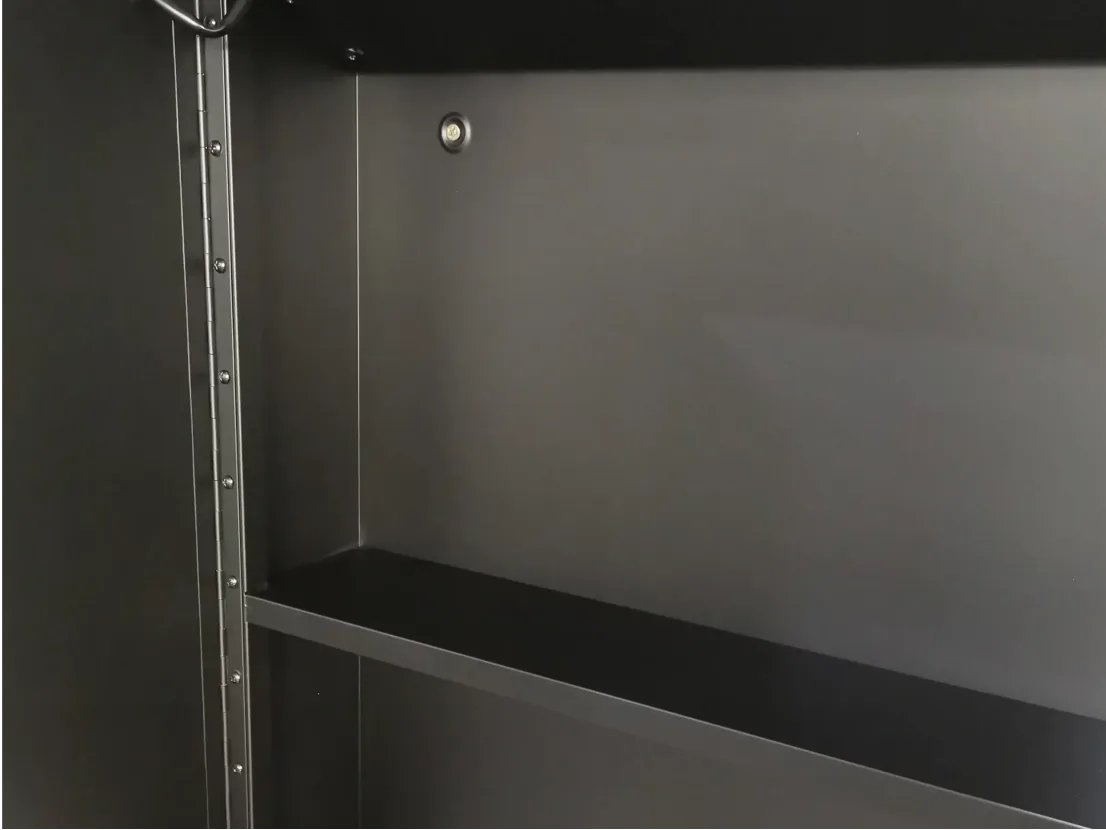
A piano hinge, or continuous hinge, is a single, long piece of articulated hardware that runs the entire vertical height of the mirror cabinet door, connecting it to the chassis without interruption.
- Mechanical Advantage – Ultimate Load Distribution: Standard hinges concentrate the massive weight of the mirror door onto two or three small anchor points. A continuous piano hinge distributes this heavy load evenly across the entire vertical axis of the mirror
- Zero Sagging: Because the torque is perfectly dispersed, a door mounted with a piano hinge is virtually immune to sagging. It is the most robust structural solution available for oversized, ultra-heavy commercial mirror doors.
3. Material Synergy: Aosmay’s Blueprint for Hardware Matching
One of the biggest mistakes inexperienced manufacturers make is using the exact same hinge for every mirror cabinet, regardless of the chassis material. Different metals possess different tensile strengths, wall thicknesses, and fabrication methods.
At Aosmay, our R&D engineering team matches specific medicine cabinet hinges types directly to the physical properties of the mirror cabinet chassis. This material synergy is what separates a retail product from a commercial-grade architectural fixture.
3.1. Aluminum mirror Cabinets + Concealed Hydraulic Hinges
For our lightweight, 100% rust-proof Anodized Aluminum mirror cabinets, we pair them with premium Concealed Hydraulic Hinges.
- The Engineering Logic: Aluminum profiles are extruded with highly precise internal channels. These channels perfectly accommodate the mounting plates of standard concealed hinges. Because the aluminum chassis is lighter, the hydraulic hinges can easily manage the weight of the door while offering the contractor the 3D adjustability needed to achieve a flawless, flush installation in upscale residential apartments.
3.2. Stainless Steel & Powder-Coated Iron Mirror Cabinet+ Continuous Piano Hinges
For our heavy-duty Premium Stainless Steel mirror cabinet and Powder-Coated Iron mirror cabinets, we exclusively specify Continuous Piano Hinges.
- The Engineering Logic: Steel and iron mirror cabinets are fabricated via bending and heavy welding, designed for extreme commercial durability in high-traffic hotels and public restrooms. These chassis are heavier, and the doors they support carry massive weight. By welding or riveting a full-length piano hinge to the steel chassis, we guarantee that the extreme dynamic weight of the door is dispersed perfectly. This combination creates an indestructible fixture capable of withstanding the most aggressive commercial wear and tear.
4. The Aosmay Medicine Cabinet Hinges Standard: 100000-Cycle Fatigue Testing
Claiming durability is one thing; proving it through empirical testing is another. For global developers importing fixtures for large-scale projects, safety certifications and quality control metrics are non-negotiable.
The reliability of Aosmay medicine cabinet hinges is validated through our stringent factory testing protocols. Every hinge system—whether a hydraulic concealed hinge on an aluminum unit or a heavy-duty piano hinge on a steel unit—is subjected to a grueling mechanical fatigue test.
The 100000-Cycle Heavy-Load Test: Inside our 50,000-square-meter facility, automated robotic arms repeatedly open and close the heavy mirrored doors under maximum payload conditions. Our hinges must flawlessly pass an 100000-cycle opening and closing fatigue test without any loss of hydraulic tension, structural sagging, or hinge pin deformation.
What This Means for Developers: This heavy-duty cycle testing simulates years of aggressive, continuous use in a commercial hotel or busy household. It provides contractors with the absolute certainty that an Aosmay mirror cabinet will perform flawlessly long after the property has been handed over.
5. FAQs
Q1: What are the best medicine cabinet hinges for heavy mirror doors?
A: For exceptionally heavy, oversized mirror doors—especially those with thick glass and integrated lighting—a Continuous Piano Hinge is the superior architectural choice. By distributing the weight across the entire height of the door, it prevents the sagging and alignment failures common with standard hinges.
Q2: How do you fix a sagging medicine cabinet door in a hotel bathroom?
A: If the mirror cabinet utilizes standard concealed hinges, a maintenance technician can typically fix sagging by adjusting the horizontal and vertical set-screws on the hinge plate. However, if the hinge arm itself is bent due to cheap zinc construction, the hinge must be replaced. Specifying an Aosmay mirror cabinet with commercial-grade hardware or a piano hinge eliminates this maintenance issue entirely.
Q3: Why do some Aosmay mirror cabinets use standard hinges while others use piano hinges?
A: Hardware must match the chassis material. Aosmay engineers pair precise, 3D-adjustable concealed hinges with our extruded aluminum mirror cabinets for sleek residential applications. Conversely, we pair indestructible continuous piano hinges with our heavy-duty Stainless Steel Mirror Cabinets and Powder Coating Mirror Cabinets to support extreme commercial loads in hospitality projects.
6. Conclusion: Engineering the Perfect Closure
In commercial bathroom architecture, a mirror cabinet is only as reliable as the hardware that holds it together. By understanding the mechanical differences between the various medicine cabinet hinges types, procurement teams can source fixtures that drastically reduce post-installation liabilities and maintenance costs.
Whether your project requires the precise adjustability of aluminum-paired hydraulic hinges for a luxury condo, or the indestructible piano hinges of a stainless steel hotel fixture, Aosmay medicine cabinet hinges are engineered, tested, and proven to meet the highest global standards.
[Explore the Aosmay Catalog by Material] or [Contact Our Engineering Team for Custom Hardware Specifications].