
A truly exceptional product line does not start on a wholesale shelf; it begins as a blank CAD file. In a saturated sanitary ware market, relying on mass-produced, standardized fixtures means surrendering your unique brand identity. For visionary plumbing distributors, independent design firms, and ambitious retail brands, the only way to dominate a specific market niche is to control the manufacturing DNA of the products you sell.
This is the true power of Original Equipment Manufacturing (OEM). When you initiate an OEM project for a lighted bathroom mirror, you are no longer just a passive buyer flipping through a catalog—you step into the role of a product architect. You dictate the rules, the aesthetics, and the engineering.
However, the journey from a conceptual sketch to a mass-produced, hardwired luminaire is filled with hundreds of technical micro-decisions. Many brand owners vastly underestimate the sheer depth of variables that can be tailored on the factory floor. This masterclass deconstructs the comprehensive customization matrix available when engineering an oem bathroom mirror. By understanding the structural, aesthetic, and electrical parameters at your disposal, you can transform a basic glass concept into a proprietary architectural asset that perfectly reflects your brand’s uncompromising standards.
1. Geometric Scaling and Form Factor of a Lighted Bathroom Mirror
The foundation of any bespoke vanity project begins with the physical footprint of the mirror. Because elite manufacturing facilities utilize advanced computerized numerical control (CNC) glass cutting, the dimensional limitations are dictated solely by your architectural blueprints and international shipping container capacities.
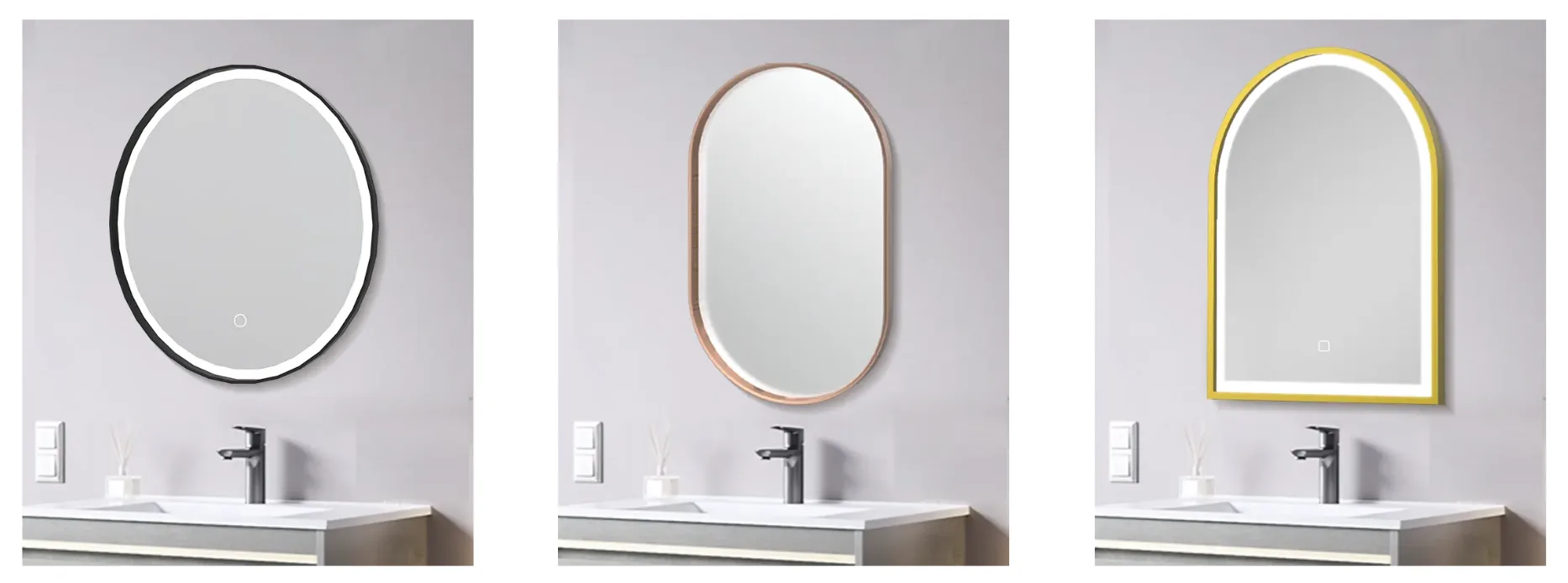
When planning your project, the physical geometry extends far beyond standard rectangles. Designers can specify exact widths to perfectly match bespoke stone vanity countertops, creating a seamless, flush aesthetic from edge to edge. If your project demands a softer visual language, CNC technology allows for the precise cutting of oversized circular mirrors, elegant pill-shapes, or trending arched (cathedral) designs. Furthermore, buyers can dictate the exact glass thickness—typically upgrading to a premium 5mm copper-free silver glass to ensure absolute reflection clarity and prevent edge oxidation in high-humidity environments.
2. Frame Metallurgy for Your OEM Bathroom Mirror
A true oem bathroom mirror offers complete control over the structural chassis and the visible framing, directly impacting both the fixture’s aesthetic and its longevity in commercial environments.
For minimalist, modern designs, project managers often specify a frameless aesthetic. In this scenario, the customization shifts to the glass edge treatment, where you can request highly polished pencil edges or deeply beveled borders for a prismatic light effect.
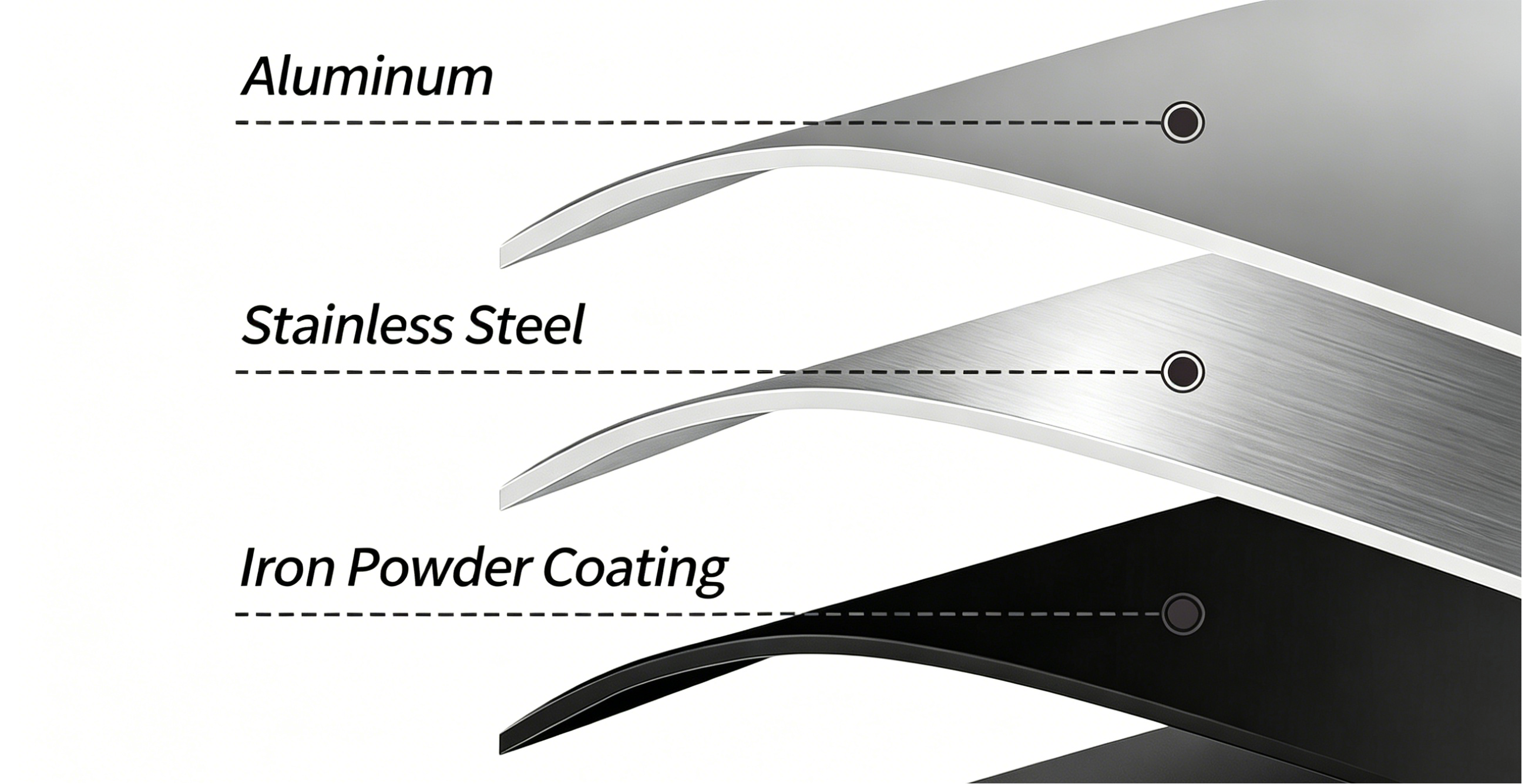
However, for industrial or luxury contemporary projects, metal framing is essential. Buyers can specify the exact metallurgy of the frame to suit the project’s climate and budget. Lightweight anodized aluminum is a frequent choice for its 100% rust-proof properties and ability to be finished in brushed gold, matte black, or polished chrome. For extreme commercial durability, heavy-duty powder-coated iron or premium stainless steel frames can be engineered. This level of material customization ensures that the mirror not only fits the visual decor but also survives the aggressive chemical cleaning protocols of hospitality housekeeping.
3. Illumination Architecture in a Lighted Bathroom Mirror
The integration of light into the glass is the most complex engineering phase of the OEM process. You are customizing a hardwired luminaire, which means every aspect of the light output is under your control.
The first major decision is the light diffusion style. Buyers can specify a “front-lit” design, where a frosted strip is sandblasted directly into the perimeter of the glass, allowing light to project forward onto the user’s face—the optimal choice for makeup application and grooming. Alternatively, a “back-lit” (halo) design can be specified, where the LEDs are hidden behind the glass, projecting light against the wall to create a dramatic, floating ambient effect.
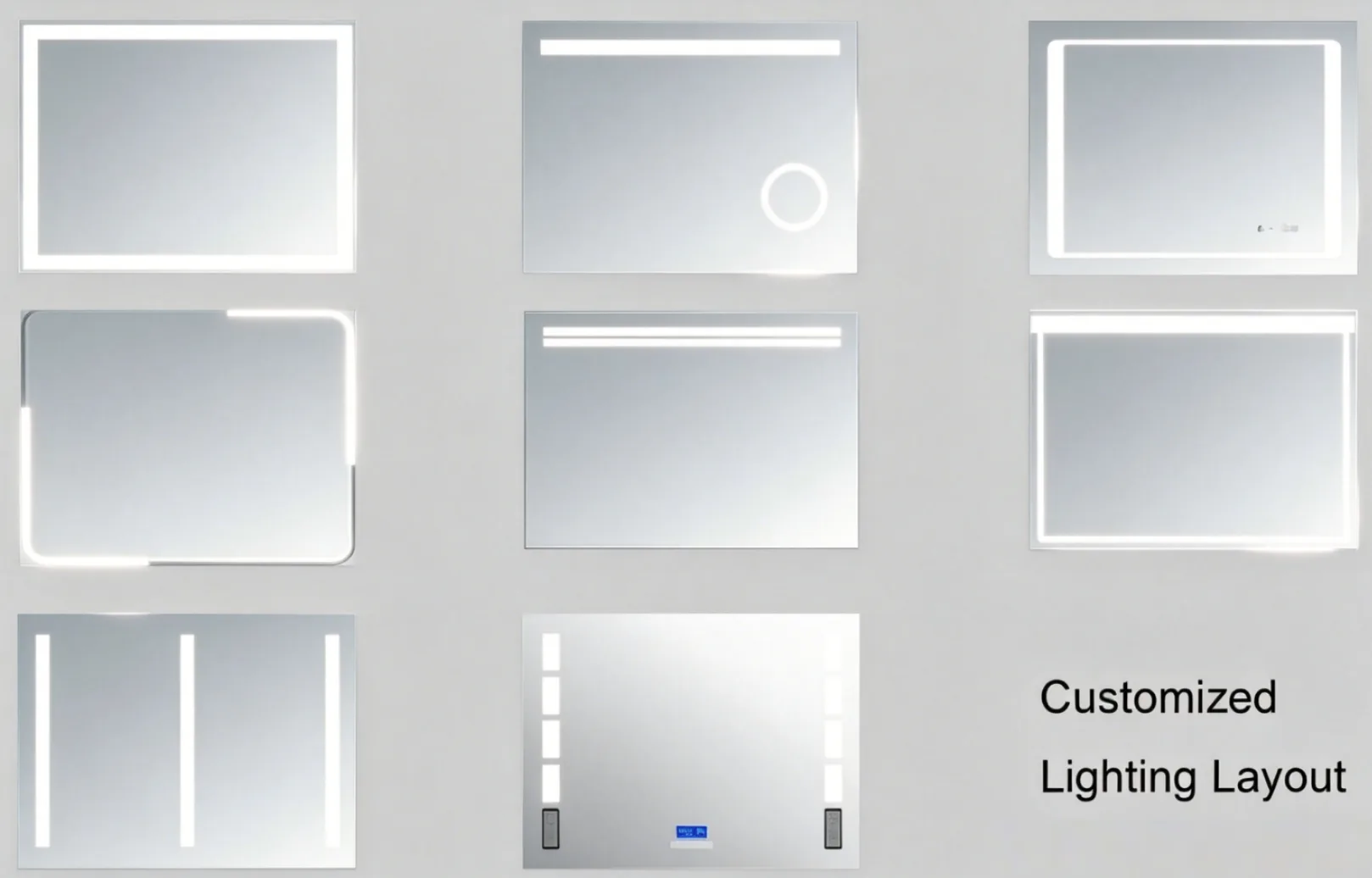
Beyond the diffusion style, the electrical specifications of the LEDs are entirely customizable. Procurement teams must dictate the Color Rendering Index (CRI > 90 is recommended for commercial projects) to ensure accurate skin tone reflection. Additionally, the Correlated Color Temperature (CCT) can be customized. You can select a fixed warm 3000K for a spa-like atmosphere, a daylight 6000K for modern apartments, or upgrade to a tunable LED system that allows the end-user to shift the color temperature seamlessly.
4. Control Interfaces and Defogging in OEM Bathroom Mirror Design
How the end-user interacts with the mirror is a crucial element of the OEM blueprint. Commercial buyers must tailor the electrical interfaces based on the target environment—whether it is a public restroom, a hotel suite, or a private residence.
For high-traffic hospitality environments, developers often request that the mirrors be hardwired directly into the bathroom’s main wall switch, completely removing any buttons from the glass for a foolproof, zero-touch guest experience. Alternatively, for retail and residential distribution, capacitive touch sensors can be laser-etched directly into the glass surface. These touch buttons can be customized to control power, dimming, and color temperature. Furthermore, bottom-mounted infrared (IR) wave sensors can be integrated for a completely hygienic, touchless operation.
Another highly customizable and critical integration is the thermal defogger system. Buyers can specify the exact size and placement of the PET electrical resistance heating pad adhered to the rear of the mirror. To ensure energy efficiency and safety, commercial buyers often customize the system to include an automatic one-hour shut-off relay, preventing the mirror from overheating if left unattended.
5. Global Compliance and Packaging for Lighted Bathroom Mirror Export
Customization does not end with the product itself; it extends to legal compliance and the logistical supply chain. An OEM order must be tailored to survive its journey and legally clear customs in its destination country.
Procurement directors must specify the required regional electrical certifications. Whether the project requires UL and ETL marks for North American building codes, or CE, RoHS, and IP44 waterproof ratings for the European market, the internal wiring, drivers, and isolation boxes must be customized to meet these strict legal parameters.
Finally, the packaging itself is a customizable asset. Buyers ordering in bulk must specify heavy-duty export protocols. This includes demanding custom-molded high-density EPE foam, reinforced corrugated cartons, and strictly enforced drop-testing standards. For retail distributors, packaging can also be customized with full-color brand graphics, localized barcode printing, and bespoke unboxing experiences designed for the end consumer.
6. The Aosmay Lighted Bathroom Mirror Standard: From Concept to Reality
Executing a multi-variable OEM project requires partnering with a facility that possesses both elite manufacturing capabilities and deep engineering expertise. When global developers and wholesale brands commission an Aosmay lighted bathroom mirror, they are leveraging a state-of-the-art 50,000-square-meter production hub dedicated to precision execution.
Aosmay streamlines the bespoke process by handling every phase under one roof. Our CNC glass cutting lines ensure your geometric visions are executed with sub-millimeter accuracy. Our metal fabrication workshops seamlessly fold and weld aluminum and steel frames to match your exact architectural finishes. Most importantly, our electrical engineers ensure that your custom illumination specs and defogging technologies are fully isolated, heat-sinked, and certified for global commercial use. By strictly focusing on the core utility and aesthetics of the mirror—completely bypassing unstable gimmicks like integrated televisions or complex wireless operating systems—we guarantee a commercial fixture that is beautiful, reliable, and perfectly aligned with your brand’s uncompromising standards.
[Contact Our Electrical Engineering Team for Custom Project Specs].
7. FAQs
Q1: What is the MOQ for a customized OEM bathroom mirror project?
A: MOQs vary depending on the depth of customization. For standard geometric changes and frame finishes, MOQs are typically highly accessible for commercial projects. However, if your project requires custom-molded frames or entirely new electronic tooling for proprietary touch interfaces, the MOQ will be adjusted to absorb the initial engineering and mold-creation costs.
Q2: Can dual lighting be integrated into a lighted bathroom mirror?
A: Yes. This is a highly requested OEM specification known as “dual-illumination.” The factory engineers a specialized internal aluminum lightbox chassis equipped with two independent LED driver channels, allowing light to project through the front frosted borders while simultaneously casting a glowing halo against the wall.
Q3: How does the factory ensure the frosted light borders perfectly match my design files?
A: During the OEM prototyping phase, your CAD drawings are programmed directly into automated sandblasting machines. This ensures that the exact width, curvature, and placement of the frosted light strips are replicated perfectly across every single unit in your bulk order, eliminating the inconsistencies of manual etching.
8. Conclusion: Engineering Your Brand’s Reflection
The true power of OEM manufacturing lies in total structural and aesthetic control. When you understand the vast array of customizable parameters—from the CNC-cut geometry and rust-proof metal framing to the high-CRI illumination and regional electrical compliance—you elevate your procurement strategy from simply buying a product to engineering a proprietary architectural asset.
By collaborating with a transparent, highly certified factory, you ensure that your exact project blueprints are translated into flawless, commercial-grade realities, protecting your profit margins and distinguishing your brand in a crowded global marketplace.