
Introduction: Why Size is a Supply Chain Strategy, Not Just an Aesthetic Choice
When commercial contractors, hospitality interior designers, and wholesale distributors evaluate illuminated bathroom mirrors, aligning architectural dimensions for a visually pleasing fit is only the foundational step. To achieve a truly optimized procurement strategy, this aesthetic focus must be complemented by a comprehensive assessment of the supply chain mechanics tied to the LED bathroom mirror size.
In global B2B sourcing, dimensions directly dictate project profitability. Expanding the evaluation criteria beyond spatial proportion allows procurement teams to proactively manage carrier oversize surcharges, minimize transit breakage rates, and accelerate warehouse inventory velocity. A massive mirror might look impressive on a CAD elevation drawing, but successfully executing that vision requires a strategic balance between design intent and logistical feasibility.
As a premier OEM manufacturer based in Foshan, Shunde, Aosmay works alongside global engineering teams and distributors to provide these critical dimensional insights. This guide breaks down standard dimensions, project-based procurement frameworks, and custom engineering options, illustrating how to choose LED bathroom mirror size parameters that secure project margins while actively avoiding the logistical traps of oversized glass.
Quick Answer: What Are the Most Common LED Bathroom Mirror Sizes?
The most common LED bathroom mirror sizes for commercial and wholesale projects are 24″ × 36″ (600 × 900 mm), 30″ × 36″ (760 × 900 mm), and 36″ × 48″ (900 × 1200 mm). For most B2B buyers, 24″ × 36″ offers the best balance between bathroom compatibility, production efficiency, container loading, and shipping cost control.
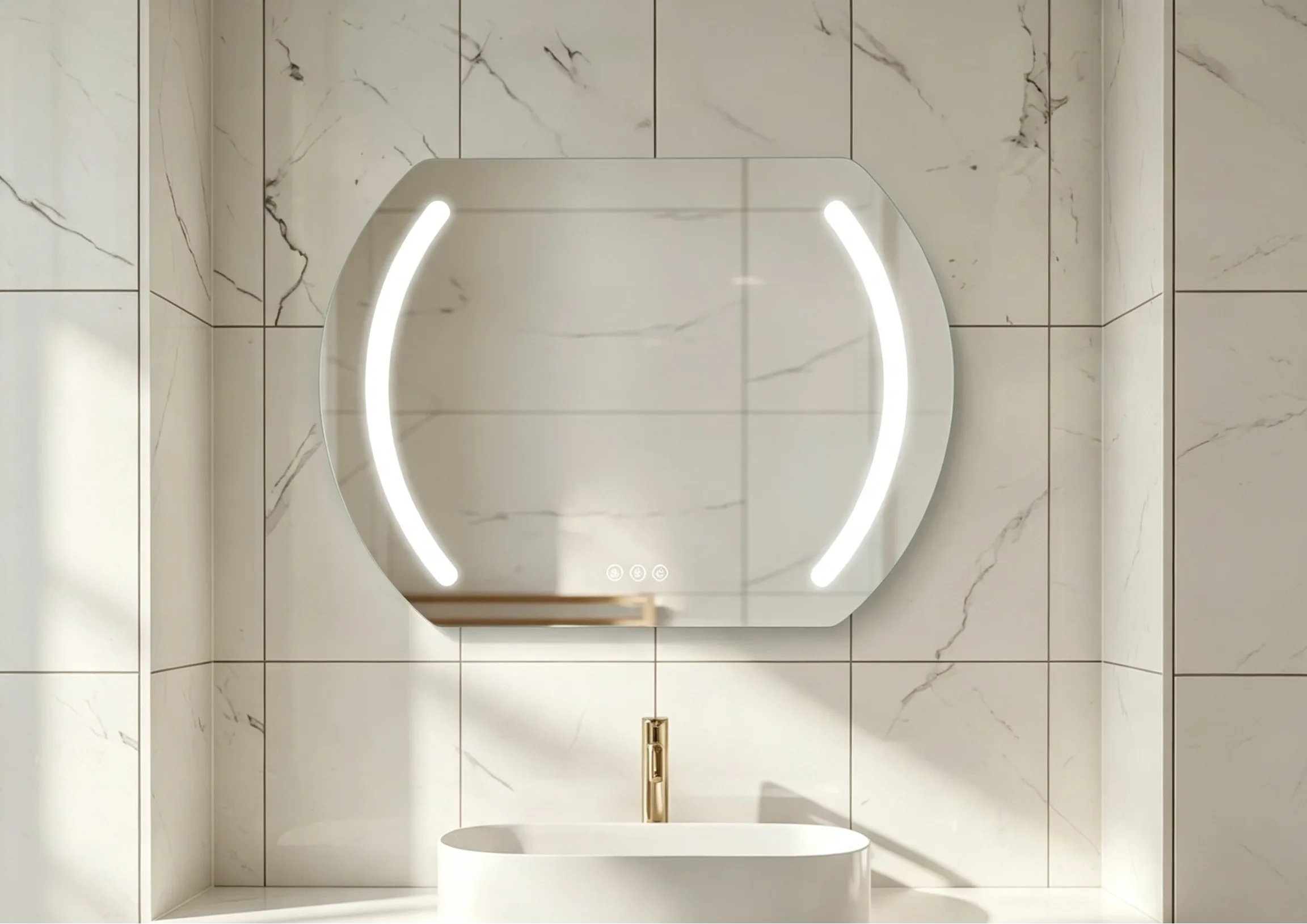
24×18 Inches Thin Bluetooth LED Vanity Mirror with SOB LED Light
Standard LED Bathroom Mirror Sizes: The 2026 Market Matrix
Based on common OEM manufacturing practices and commercial project requirements from global supply chain analytics, standardizing fixture dimensions across a project can reduce overall logistics and replacement costs by up to 28%. To structure a profitable product catalog or specify fixtures for a high-density development, procurement teams must rely on proven global dimension standards.
The following matrix details the most efficient and commercially viable LED bathroom mirror size options in both Imperial and Metric measurements.
Vanity Type & Width | Recommended Mirror Size (W x H) | Metric Equivalent (mm) | Dominant Target Project |
Powder Room (24″) | 20″ x 30″ or 24″ x 36″ | 500 x 750 / 600 x 900 mm | High-density apartments, guest baths |
Standard Single (30″ – 36″) | 28″ x 36″ or 30″ x 36″ | 700 x 900 / 760 x 900 mm | Multi-family housing, boutique hotels |
Large Single (48″) | 42″ x 36″ or 48″ x 36″ | 1060 x 900 / 1200 x 900 mm | Master bathrooms, upscale suites |
Double Vanity (60″ – 72″) | (2x) 24″ x 36″ or (2x) 28″ x 36″ | (2x) 600×900 / (2x) 700×900 mm | Commercial hospitality, luxury condos |
Statement Arch (30″ – 36″) | 24″ x 38″ Arch | 600 x 960 mm | Design-forward retail, modern lodging |
Bathroom Vanity Matching Guide: Architectural Proportions
One of the most common challenges for B2B procurement teams is selecting a mirror size that maintains proper visual balance with the bathroom vanity. Based on common commercial bathroom design practices, LED mirrors are typically specified slightly narrower than the vanity width to create balanced proportions and allow sufficient installation clearance.
According to common bathroom design practices referenced by professional kitchen and bath designers, mirrors are typically sized slightly narrower than the vanity width to maintain balanced visual proportions.
- 24-Inch Vanity: Match with a 20-inch wide mirror to leave a precise 2-inch reveal on both sides, ensuring the mirror does not extend past the sink basin.
- 30-Inch Vanity: Match with a 24-inch or 28-inch wide mirror. This is the optimal configuration for incorporating vertical side sconce lighting without crowding the wall.
- 36-Inch Vanity: Match with a 30-inch to 32-inch wide mirror, the absolute standard for premium single-sink hotel bathrooms.
- 48-Inch Vanity: Match with a 42-inch to 46-inch wide mirror.
- 60-Inch to 72-Inch Vanity: Always transition to a Twin Mirror setup (e.g., two 24-inch wide mirrors aligned perfectly over the center drain of each sink).
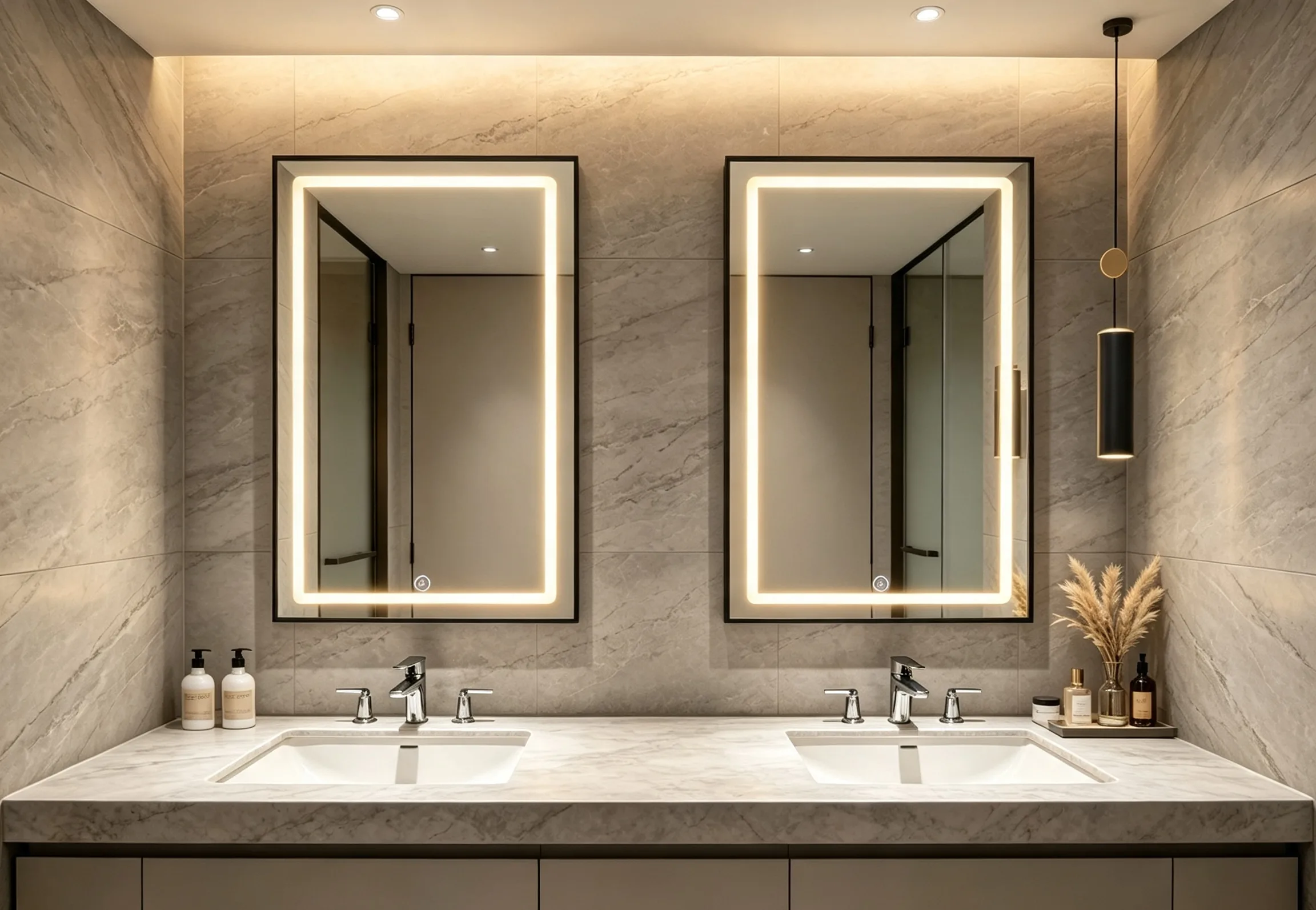
Aosmay 24×39 Inch Black Framed Mirror Bathroom with Tilted Angle
How to Choose LED Bathroom Mirror Size: A Project-Based Approach
Selecting the right dimensions is not a one-size-fits-all exercise. Different commercial sales channels operate under distinct constraints.
For Multi-Family Residential & Apartment Projects
In multi-family construction, budget efficiency and rapid installation take precedence.
- The Sizing Strategy: Standardize on 24″ x 36″ (600 x 900 mm) or 30″ x 36″ (760 x 900 mm). These dimensions fit perfectly over standard single vanities while leaving sufficient wall space for side sconces.
- Procurement Advantage: Sticking to standard sizes allows for high-volume automated production runs, maximizing unit cost savings and enabling predictable container loading density.
For Double Vanities: The “Twin Mirror” Strategy (Avoiding the Oversize Trap)
When designing for large 60-inch to 72-inch double vanities in luxury hotels or master bathrooms, many buyers mistakenly attempt to source a single, massive 72-inch LED mirror. In 2026, industry experts strongly advise against this.
Manufacturing a single oversized glass pane incurs disproportionately high production costs, and more importantly, it introduces extreme logistical hazards. Oversized mirrors have a highly elevated risk of micro-fractures and shattering during international ocean freight and domestic LTL transit.
- The Superior Solution: Top commercial designers now universally specify Twin Mirrors (e.g., mounting two identical 24″ x 36″ mirrors side-by-side over each sink).
- The ROI Benefit: This twin setup not only creates a highly sought-after “his and hers” luxury aesthetic but also completely eliminates oversized shipping penalties and drastically slashes the breakage replacement costs to near zero.
For E-Commerce & Retail Wholesale
E-commerce distributors must evaluate product size entirely through the lens of parcel delivery networks.
- The Sizing Strategy: Focus on the “Golden Parcel Window”—24″ x 36″ down to 20″ x 30”.
- Logistics Thresholds: Major parcel couriers enforce strict Length + Girth limits (typically 130 inches). Keeping boxed dimensions within standard parcel limits preserves e-commerce profit margins and simplifies last-mile fulfillment.
The Hidden Cost: How Mirror Size Impacts Shipping and Packaging
A common mistake in B2B procurement is designing a mirror based solely on wall dimensions without calculating its Dimensional Weight (DIM Weight) and packaging footprint.
Key Industry Insight: Glass is inherently dense and fragile. As a single mirror’s surface area increases, the required protective packaging thickness grows exponentially. This is the exact reason why experienced distributors actively avoid stocking overly massive mirrors, opting instead for modular twin-mirror designs.
To prevent catastrophic transit breakage for standard commercial sizes, units must be encased in engineered transit packaging. At Aosmay, our logistics engineering team designs transit armor tailored to the chassis size:
- ISTA 6-Amazon Certified Cartons: Constructed from heavy-duty honeycomb corrugated cardboard that resists compression during pallet stacking.
- Custom-Molded EPE Armor: We utilize high-density Expanded Polyethylene (EPE) foam instead of brittle EPS styrofoam to ensure copper-free silver glass arrives intact.

Beyond Standard Dimensions: Engineering Custom Bathroom Mirror Sizes
When standard off-the-shelf options fail to meet specific architectural blueprints, working with an adaptive OEM factory becomes essential. Investing in custom bathroom mirror sizes allows developers to maximize spatial geometry and create proprietary product lines.
What Can Be Customized in Commercial Production?
- Precision Chassis Dimensions: Precision laser-cutting of aluminum frames and powder coating structures to match exact architectural wall dimensions down to the millimeter.
- Structural Depth & Metal Finishes: Adjusting frame depth from ultra-slim profiles to architectural reveals, finished in electrostatic matte black, brushed brass, or anodized silver.
- Light Output & Optics: Customizing perimeter frosted glass margins and LED strip density to achieve targeted Lux output across the face plane.
- Integrated Mounting Systems: Engineering commercial-grade Z-bar hanging systems customized to the mirror’s precise center of gravity.
To support commercial project planning, Aosmay provides professional engineering support for wholesale clients and project developers, transforming architectural specifications and CAD elevations into production-ready technical drawings before sample fabrication. This ensures accurate dimensions, optimized manufacturing processes, and reliable project execution.
Frequently Asked Questions
Q1: Should the LED mirror be exactly the same size as the vanity?
No. As a general architectural rule, the mirror should be 2 to 4 inches narrower than the vanity countertop below it (e.g., a 32″ to 34″ mirror for a 36″ vanity). This creates a balanced visual margin and prevents the mirror from appearing top-heavy.
Q2: What is the most popular LED bathroom mirror size for wholesale?
The 24″ x 36″ (600 x 900 mm) rectangular mirror is the highest-volume SKU globally. It provides an ideal balance of functional vertical coverage, universal vanity fit, optimized FCL container loading density, and standard parcel shipping compliance without triggering oversize fees.
Q3: Can Aosmay manufacture Custom Bathroom Mirror Sizes for commercial hotel projects?
Yes. As a specialized OEM/ODM manufacturer, Aosmay develops custom bathroom mirror solutions, including non-standard dimensions, tailored chassis structures, and customized LED configurations. We collaborate with commercial clients throughout the product development process, from specification optimization and engineering validation to ISTA-certified packaging solutions, ensuring efficient manufacturing and secure transportation.
Q4: What LED bathroom mirror size is best for hotel projects?
For hotel projects, 24″ × 36″ and 30″ × 36″ are commonly selected because they provide consistent appearance across multiple rooms while simplifying replacement and maintenance.
Q5: Are larger LED bathroom mirrors better for commercial projects?
Not always. Oversized mirrors increase packaging requirements, transportation costs, and replacement risks. Many commercial projects prefer multiple standard-size mirrors for better supply chain efficiency.
Q6: Can LED bathroom mirrors be customized for OEM orders?
Yes. OEM manufacturers can customize dimensions, frame structures, LED layouts, and installation systems according to project requirements.
Conclusion: Secure Your Margins with the Right Dimensions
Mastering how to choose LED bathroom mirror size options is a vital skill for modern B2B buyers. By balancing wall proportions against carrier shipping limits and actively avoiding the logistics trap of overly massive glass panes in favor of twin-mirror installations, you can build a resilient, high-margin inventory strategy.
Partnering with an experienced manufacturer ensures that whether you choose standard stock matrices or custom bathroom mirror sizes, your mirror line is backed by commercial-grade surface finishing and transit-ready packaging.
Optimize Your Product Dimensions Today
Need technical guidance or custom CAD layouts for your next commercial project?
Our engineering group can review your architectural specs, calculate optimal packaging volumes, and provide tailored product proposals. [Contact Aosmay’s OEM/ODM Engineering Group] today to request technical consultation, material sampling, or a free design layout provision for your project.