
As we navigate the 2026 architectural landscape, technology integration within sanitary spaces has become a defining trend in commercial and residential projects. According to recent global industry forecasts from Smart Bathroom Market Report 2026 – Research and Markets, the global smart bathroom market is projected to reach $5.8 billion in 2026, with the lighted mirror medicine cabinet segment recording a 10.2% CAGR, driven by rapid apartment construction and high-end hospitality developments. As a result, commercial bathroom mirror and LED medicine cabinet solutions are becoming standard specifications for modern vanity spaces.
From anti-fog mirror cabinet technology and high CRI bathroom mirror lighting to touch sensor medicine cabinet controls and Bluetooth audio integration, today’s products offer more intelligent features than ever before. However, for developers, hospitality procurement directors, wholesalers, and contractors, selecting the right configuration is no longer about choosing the most features—it is about balancing functionality, durability, maintenance, and long-term ROI.
This whitepaper provides a practical, data-driven framework for evaluating smart features based on user demographics, product lifecycles, and engineering value. The guidance is equally applicable to LED medicine cabinet, custom medicine cabinet, and large-scale OEM procurement projects.
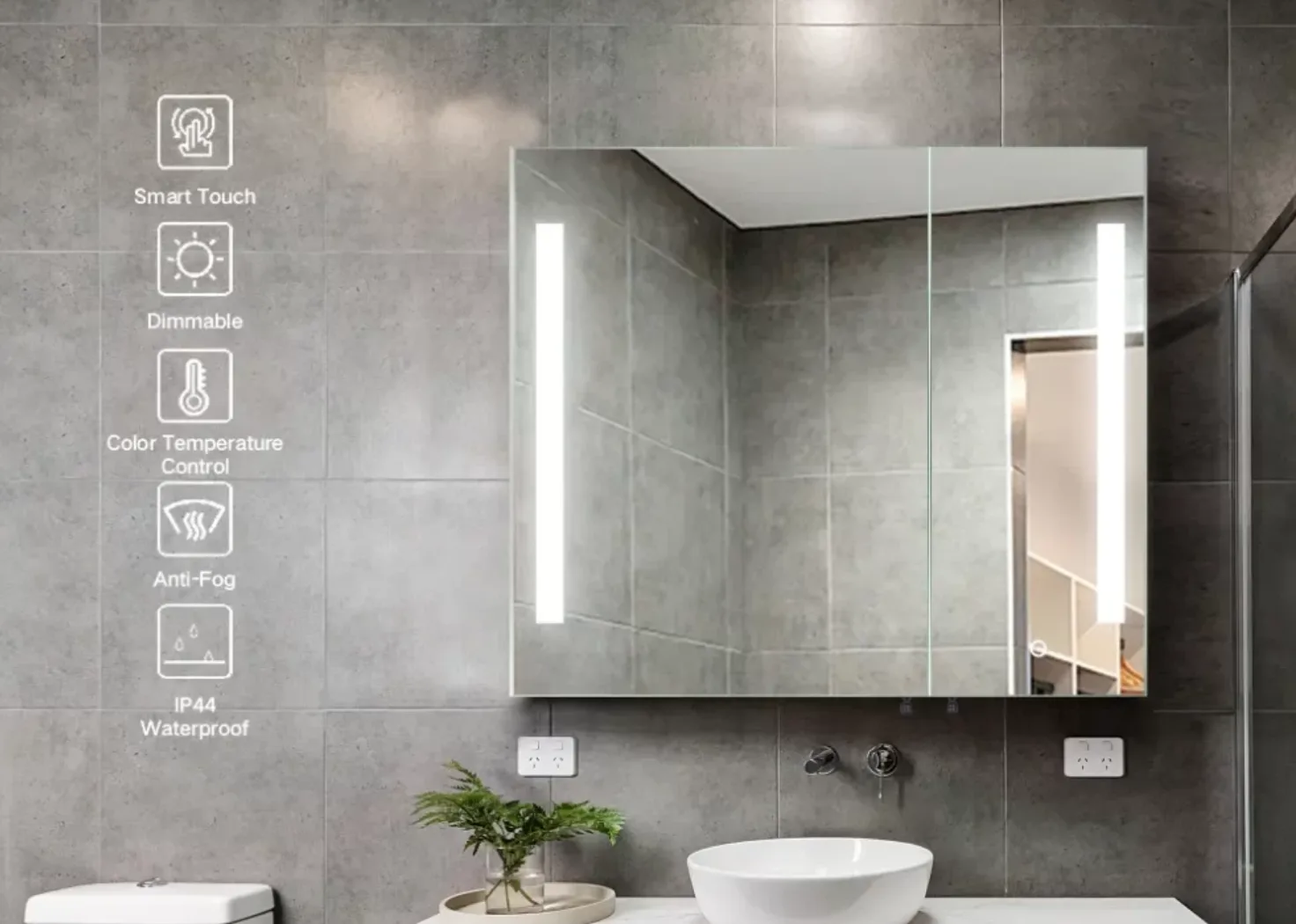
1. The Matrix of User Demographics: Aligning Features with Occupant Profiles
The first step in defining the ideal feature set for a lighted mirror medicine cabinet is analyzing the final occupant profile. User expectations vary significantly across different real estate sectors, meaning a feature that represents a luxury asset in one property could become underutilized overhead in another.
High-Density Multi-Family Housing vs. Extended-Stay Hospitality
In premium multi-family residential projects, occupants interact with the fixture daily as their primary storage and grooming station. For these long-term residents, features that enhance convenience and lifestyle integration—such as integrated digital clocks, ambient dimming, and Bluetooth audio synchronization—add tangible lifestyle value.
Conversely, short-stay hospitality environments place a premium on intuitive, frictionless operation. A hotel guest arriving late at night requires immediate, self-explanatory functionality. In this scenario, complex multi-button control panels or sync-heavy digital interfaces can occasionally lead to operational confusion.
Therefore, procurement teams must balance the desire for advanced tech options with the operational reality of the guest experience, ensuring that integrated features match the technological comfort level of the target demographic. This evaluation process is especially important for hotel bathroom mirror cabinet, hospitality bathroom mirror, and apartment bathroom mirror cabinet projects, where user expectations and operational requirements differ considerably.
2. Analyzing the Technical Lifecycles: Structural Components vs. Consumer Electronics
A critical engineering consideration for any commercial specifier is the inherent disconnect between the physical lifecycle of architectural furniture and the rapid obsolescence curve of consumer electronics.
A premium cabinet chassis constructed from anodized powder coating mirror cabinet ,aluminum mirror cabinet or stainless steel mirror cabinet , paired with 5mm copper-free silver glass, possesses an architectural lifespan typically extending beyond a decade. However, complex printed circuit boards (PCBs), liquid crystal displays (LCDs) for weather tracking, and Bluetooth receivers follow the much shorter evolutionary cycle of consumer technology.
Environmental Stress Factors in Wet Zones
Furthermore, the micro-climate of a bathroom presents unique environmental challenges. High humidity, localized steam accumulation, and the regular use of chemical cleaning agents accelerate the aging of electronic components.
When specifying commercial bathroom mirror and commercial medicine cabinet installations with highly integrated electronic suites, procurement directors must evaluate the serviceability of those components. True commercial-grade engineering treats complex digital modules as field-replaceable units (FRUs) or isolates them into distinct, moisture-sealed compartments. This ensures that if a digital sub-component requires maintenance or becomes obsolete after several years, it can be serviced independently without requiring the premature replacement of the entire structural cabinet.
When specifying advanced digital integrations, procurement teams should also prioritize modular medicine cabinet architecture together with IP44 mirror cabinet protection to improve long-term maintenance efficiency.
3. Core Functional Baselines: Prioritizing the Fundamentals of Vanity Design
While secondary lifestyle features enhance premium tiers, certain fundamental technologies serve as the essential baseline for any high-performance lighted mirror medicine cabinet or LED medicine cabinet. These core features directly address the primary physical purposes of the fixture: visibility, clarity, and storage.
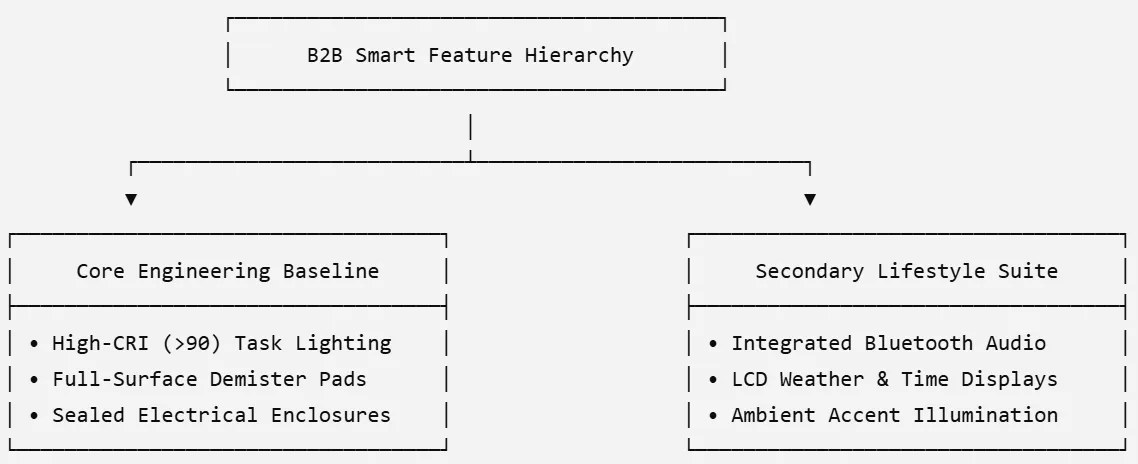
High-CRI Task Illumination
For commercial bathroom projects, CRI above 90 is generally considered the preferred specification for grooming-oriented lighting because it provides more accurate color reproduction and a more natural visual experience.
The value of a lighted mirror medicine cabinet is governed by its optical metrics. Sourcing specifications should strictly require a Color Rendering Index (CRI) of greater than 90. High CRI bathroom mirror lighting accurately replicates natural daylight, which is crucial for grooming tasks. Additionally, the integration of high-density LED strips combined with professional acrylic diffusers eliminates visible “hotspots,” providing a continuous, smooth output that prevents harsh facial shadowing.
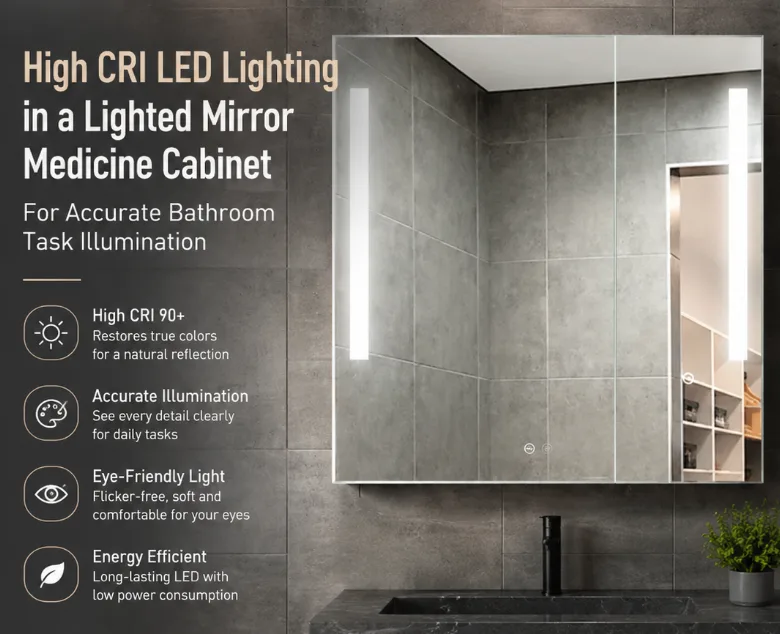
Integrated Demister Mechanisms
Full-surface heating pads are standard in modern commercial specifications to maintain mirror clarity post-shower. To optimize energy usage across large-scale properties, advanced specifications often integrate these anti-fog mirror cabinet systems with automatic shut-off relays (such as a 30 or 60-minute internal timer). This structural safety feature prevents constant energy consumption if an occupant leaves the system running continuously.
4. Internal Architecture Selection: The Engineering Trade-Off of Interior Lighting
When configuring the interior layout of an LED medicine cabinet, procurement teams frequently choose between incorporating medicine cabinet with internal lights or leaving the interior purely structural. Both approaches offer distinct design and operational advantages depending on the project goals.
The Case for Internal LED Integration
Cabinets equipped with internal LED strips or motion-activated proximity lighting offer enhanced visibility, particularly in deep or wide cabinet models. This feature assists users in locating small cosmetic or medical items in low-ambient light conditions, elevating the premium feel of the master suite. Specifiers choosing this path must ensure the internal wiring channels are fully recessed and protected by IP44 mirror cabinet waterproof sealing to withstand interior moisture from damp stored items.
The Structural Optimization Approach
Alternatively, omitting internal lighting and keeping the cabinet interior purely structural focuses on maximizing usable physical volume and long-term reliability.
Without the need for internal wiring conduits, transformer housings, or diffuser tracks, the interior walls remain thin and rigid. This allows for maximum edge-to-edge storage width and a deeper clearance for adjustable tempered glass shelves. For high-density projects where cubic storage capacity per square foot is the primary metric, a purely structural interior eliminates maintenance points inside the closed storage zone while delivering an uncomplicated, high-capacity layout. This approach is often preferred for commercial medicine cabinet installations where durability and storage efficiency take precedence over additional electronic features.
5. B2B Sourcing FAQ: Managing Smart Specifications & Customization
Q1: Can different feature configurations be customized for different commercial project requirements?
Yes. Commercial projects often include multiple application scenarios, such as hotel guest rooms, executive suites, serviced apartments, healthcare facilities, and public washrooms, each requiring different functional priorities.
As an experienced Aosmay LED medicine cabinet OEM/ODM manufacturer, we support flexible feature customization based on project specifications. Depending on the product model and manufacturing requirements, buyers can select practical configurations for standard applications or premium options—such as Bluetooth mirror cabinet systems, capacitive dimming, or custom medicine cabinet interior lighting—for high-end spaces. Our engineering team works closely with customers to develop solutions that balance project budgets, user experience, and manufacturing efficiency.
Q2: What are the engineering boundaries for custom digital integrations like LCD displays or audio systems?
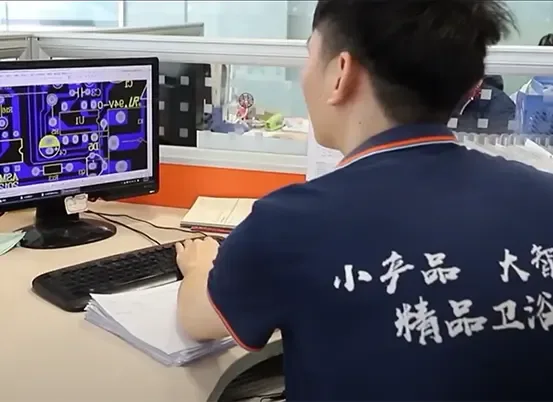
The primary boundary is environmental protection. When implementing custom medicine cabinet electronics such as Bluetooth receivers or digital time/weather displays, the hardware must be completely isolated from ambient moisture.
Aosmay engineering team designs dedicated, sealed metal junction boxes with independent IP44 mirror cabinet waterproof enclosures to house these sensitive PCBs. This engineering approach helps maintain long-term reliability without compromising the structural durability of the cabinet.
Q3: Which smart features deliver the best long-term value for commercial projects?
Not every smart feature provides the same return on investment. For most commercial developments, procurement teams should prioritize core technologies such as high CRI bathroom mirror lighting, anti-fog mirror cabinet systems, durable touch controls, and reliable electrical protection before considering premium lifestyle features like Bluetooth audio or digital displays. Selecting features based on actual user needs, maintenance requirements, and project positioning helps reduce long-term operating costs while improving occupant satisfaction.
Q4: What smart features provide the best ROI in a bathroom mirror cabinet?
For most commercial projects, the highest ROI features are those that improve daily usability and reduce maintenance costs. High-CRI LED lighting, anti-fog mirror technology, durable touch controls, and reliable electrical protection usually provide more long-term value than advanced features such as Bluetooth audio or digital displays.
6. The Balanced B2B Procurement Evaluation Guide
To assist procurement teams in aligning their technical specifications with actual project budgets and durability goals, the following matrix categorizes features by their primary operational profiles and project outcomes.
Smart Feature Specification Matrix
Functional Category | Core Technologies | Primary Project Benefit | Key Sourcing Consideration |
Essential Optical | CRI >90 LEDs, Frosted Uniform Diffusers | Eliminates shadows; provides professional-grade high CRI bathroom mirror task lighting. | |
Clarity Control | Heated Demister Pads with Automated Timers | Maintains mirror usability in high-steam environments; prevents energy waste. | Ensure the timing relay is independent of the main lighting switch. |
Digital Integration | LCD Clocks, Bluetooth mirror cabinet Audio Receivers | Enhances end-user convenience and modern property marketability. | Require modular, moisture-isolated PCB housings for easy field replacement. |
Interior Optimization | Medicine cabinet with internal lights vs. Pure Structural Layout | Internal LEDs enhance visibility; structural layouts maximize storage volume. | Balance the desire for internal illumination against strict cubic volume requirements. |
Physical Controls | Touch sensor medicine cabinet controls, Proximity Sensors | Seamless, easy-to-clean glass surfaces; high cycle lifecycles. | Check IP44 mirror cabinet waterproof ratings for all localized sensor compartments. |
7. Conclusion: Engineering a Sustainable Technology Strategy
Navigating the lighted mirror medicine cabinet market requires a strategic balance between immediate design appeal and long-term asset performance. A feature-rich product can significantly enhance a property’s marketability and fulfill specific end-user demands, provided the underlying electronic architecture is engineered for a commercial wet environment.
By systematically evaluating options through the lenses of user demographics, technical component lifecycles, and structural versus electrical trade-offs, B2B procurement professionals can look past market buzzwords. Designing a specification tailored to the precise structural and technological needs of a project ensures a reliable installation that controls maintenance costs and delivers a refined user experience.
Whether sourcing a lighted mirror medicine cabinet, developing a custom medicine cabinet, or partnering with an experienced LED mirror cabinet manufacturer, bathroom mirror cabinet supplier, or medicine cabinet wholesale partner, selecting features based on lifecycle value rather than feature quantity ensures stronger long-term ROI.
Aosmay combines OEM/ODM manufacturing expertise with flexible engineering capabilities to deliver LED medicine cabinet solutions for hotels, apartments, healthcare facilities, and commercial developments worldwide.
[Contact Our Engineering Group to Request Detailed Technical Product Specifications].