
Quick Answer:
For most bathrooms, a 4-inch medicine cabinet depth is a practical starting point because it provides useful storage while keeping the cabinet relatively close to the wall. A 6-inch medicine cabinet depth is better when users need more storage capacity for taller bottles, skincare products, grooming accessories or family-size toiletries. Deeper medicine cabinets can increase capacity, but they also increase wall projection and may affect ergonomics, door clearance and the visual balance of the bathroom.
For B2B projects, buyers can also explore Aosmay’s LED medicine cabinets for customizable storage configurations, lighting and electrical options.
The right choice is therefore not simply “the deeper, the better.” For residential bathrooms, hotels, apartments and commercial projects, the best medicine cabinet storage depth depends on installation type, wall structure, product dimensions, user reach, vanity configuration and the intended storage load.
Why Medicine Cabinet Depth Matters More Than You Think
When buyers compare medicine cabinets, width and height are usually the first dimensions they consider. Depth is often treated as a secondary specification.
That can be a mistake.
Depth directly determines three things:
- How much usable storage the medicine cabinet provides
- How far the medicine cabinet projects into the bathroom
- How easily users can reach and organize items
A medicine cabinet that is too shallow may look elegant but fail to accommodate everyday products. A medicine cabinet that is too deep may provide additional capacity while creating unnecessary projection over the vanity.
Current bathroom sizing guides commonly place medicine cabinet depth around 4–6 inches, while approximately 4 inches remains a common configuration for recessed installations. Surface-mounted cabinets commonly project farther from the wall.
For B2B buyers, depth also affects more than user experience. It can influence medicine cabinet construction, packaging dimensions, shipping volume, installation requirements and the final appearance of an entire bathroom project.
How to Choose Medicine Cabinet Depth
There is no single universal depth that works for every bathroom. The following matrix is a useful starting point for specification and procurement.
Medicine Cabinet Depth | Best For | Storage Capacity | Wall Projection | Installation Consideration |
3–4 in. | Minimalist bathrooms, recessed mirror cabinets | Basic | Low | Excellent for flush installation |
4 in. | Most standard bathrooms | Medium | Low–Medium | Good balance of storage and clearance |
5 in. | Larger daily-use storage | Medium–High | Medium | Check vanity and door clearance |
6 in. | Family bathrooms, skincare storage, hospitality | High | Higher | Better for taller products |
7–8+ in. | Special projects / maximum storage | Very High | High | Requires careful ergonomic and spatial planning |
The important distinction is between nominal cabinet depth and usable internal storage depth.
For example, the exterior mirror cabinet depth may include the back panel, frame, door and hardware. The actual space available for toiletries can therefore be smaller than the advertised overall dimension.
When comparing suppliers, always ask for:
Overall mirror cabinet depth + internal usable storage depth + door projection.
That three-part specification gives buyers a much clearer picture of real-world capacity.
4-Inch vs. 6-Inch Medicine Cabinet Depth: Which Is Better?
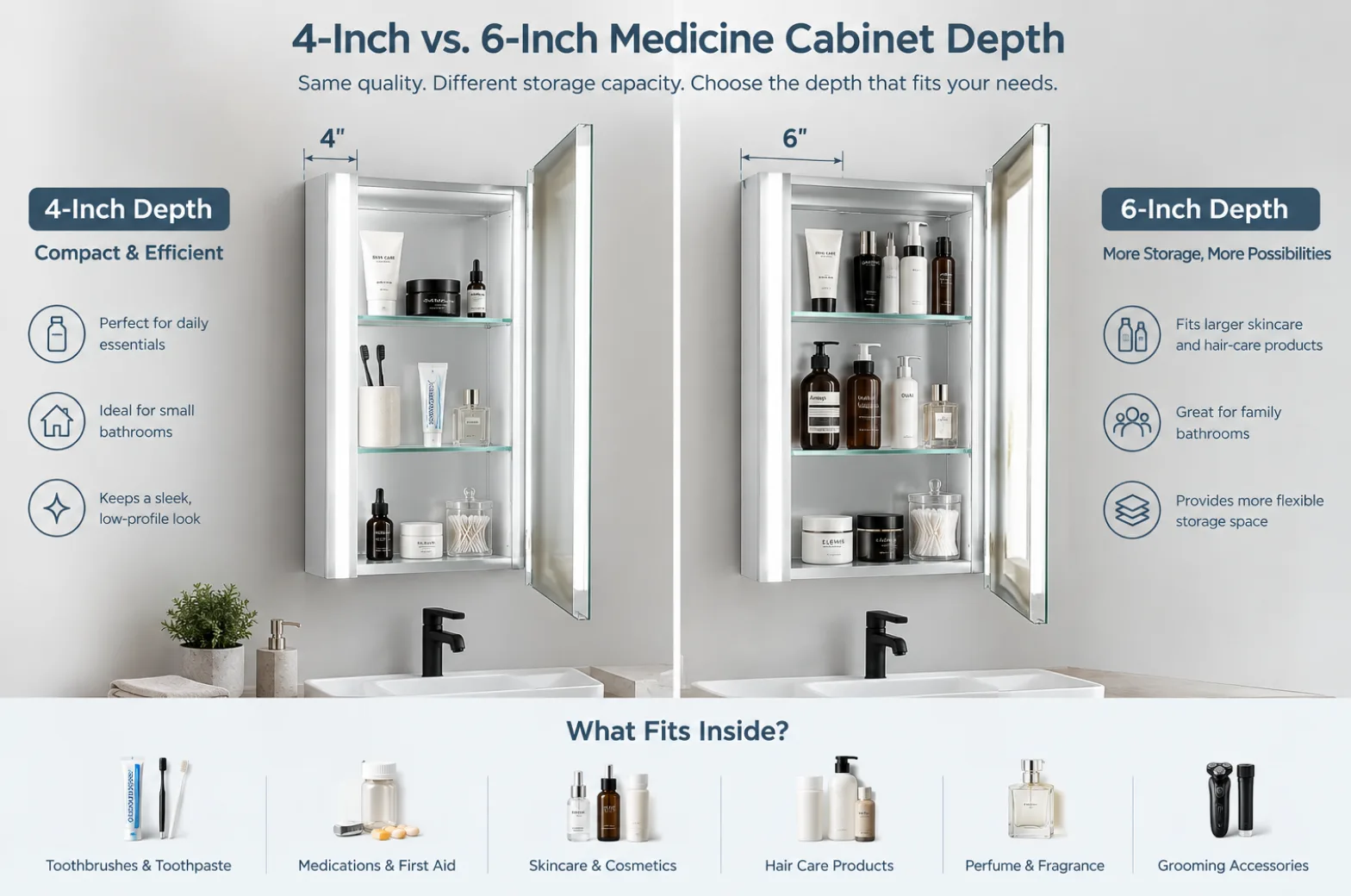
This is one of the most useful comparisons for homeowners, designers and project buyers.
- 4-Inch Medicine Cabinet
A 4-inch configuration is generally a strong choice when the priority is space efficiency.
It works particularly well for:
- Guest bathrooms
- Compact apartments
- Small hotel bathrooms
- Recessed installations
- Minimalist bathroom designs
- Projects where wall projection must be minimized
The advantage is not simply aesthetics. A shallower cabinet reduces the amount of medicine cabinet volume extending into the user’s movement zone.
For many projects, 4 inches represents a practical compromise between storage and spatial efficiency.
- 6-Inch Medicine Cabinet
A 6-inch cabinet becomes more attractive when storage is a major purchasing requirement.
It can better accommodate:
- Larger skincare containers
- Shampoo and conditioner bottles
- Electric grooming accessories
- Cosmetic containers
- First-aid products
- Multiple users’ daily toiletries
Some current bathroom medicine cabinet guides specifically identify 6 inches as a useful upgrade when users need additional storage beyond the typical 4-inch configuration.
However, a deeper cabinet should not automatically be specified for every bathroom.
The correct question is not “How deep can we make it?” but “How deep does the user actually need it to be?”
Choose Medicine Cabinet Depth Based on What You Store
A useful procurement method is to measure the products that will actually live inside the mirror cabinet.
If your storage consists mainly of:
- Toothbrushes
- Toothpaste
- Small medication packages
- Razors
- Cosmetics
- Small skincare bottles
A 3–4 inch medicine cabinet depth may be sufficient.
If your storage includes:
- Tall skincare bottles
- Perfume bottles
- Hair-care products
- Electric grooming devices
- Larger cosmetic containers
A 5–6 inch medicine cabinet depth is usually more practical.
If the cabinet is intended for:
- Family bathrooms
- Hotel suites
- Premium apartments
- High-storage master bathrooms
- Commercial hospitality projects
Consider a deeper configuration or a combination of adjustable shelves + optimized internal layout rather than simply increasing exterior depth.
This is an important engineering principle: usable storage volume matters more than external mirror cabinet depth.
Ergonomics: Why Deeper Is Not Always Better
Medicine cabinet design should follow the user’s reach rather than storage volume alone.
The U.S. Access Board’s accessibility standards provide useful reference points for reach planning. For an unobstructed forward reach, the maximum high forward reach is 48 inches (1220 mm) and the minimum low reach is 15 inches (380 mm) above the finished floor. The standards also specify reach-related requirements for accessible storage and shelves.
These standards do not mean that every residential medicine cabinet must be installed exactly according to ADA dimensions. Instead, they provide an important ergonomic reference.
For inclusive bathroom design, designers should consider:
- Who will use the cabinet?
- How tall are the primary users?
- Can users comfortably reach the upper shelves?
- Does cabinet depth force users to lean forward?
- Does the open door interfere with the user?
- Is the deepest storage located where it is easiest to access?
A deeper cabinet is most useful when its additional storage remains easy to see and reach.
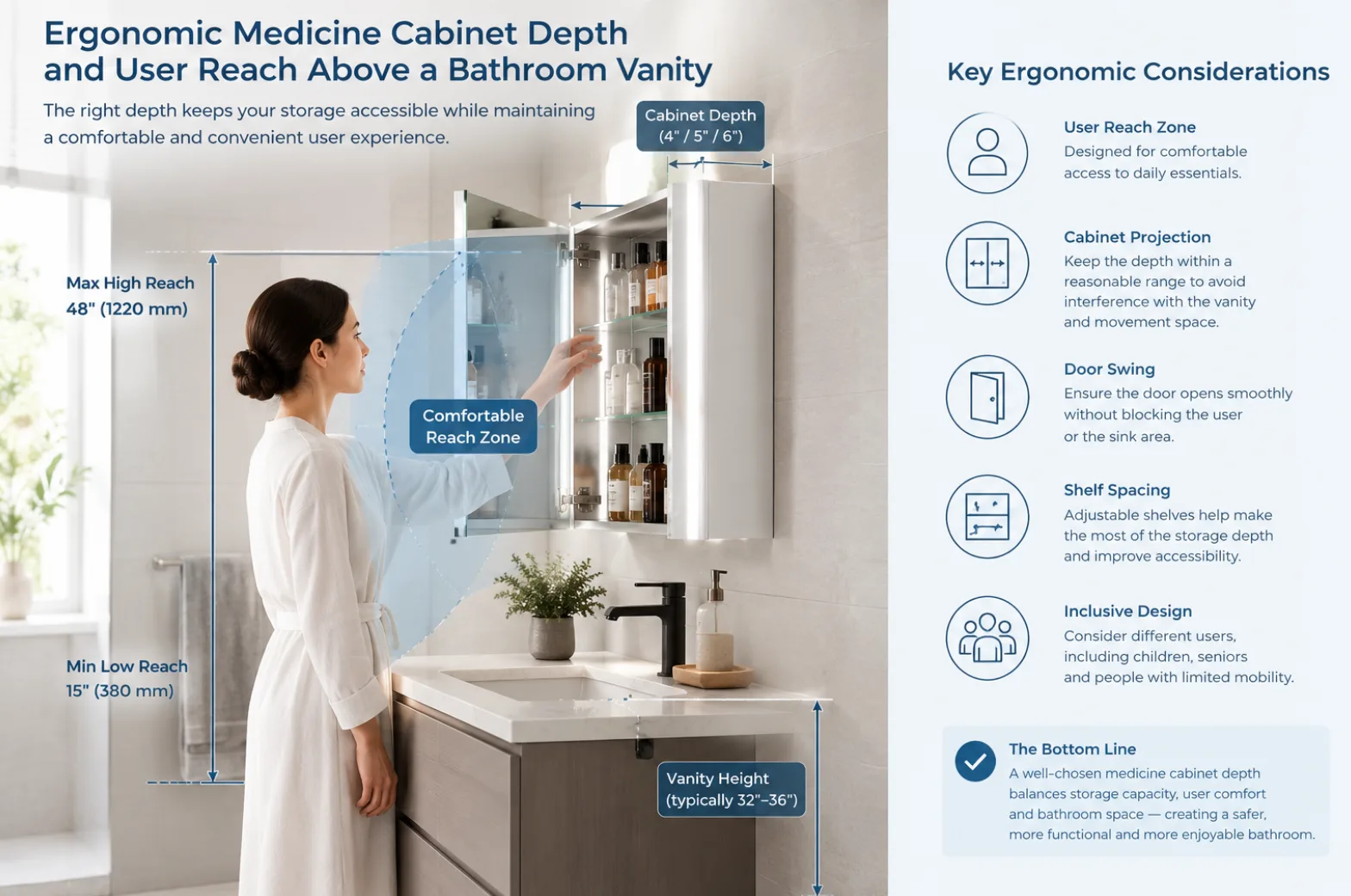
This is why shelf spacing and cabinet organization can be just as important as depth.
A Practical Medicine Cabinet Depth Decision Matrix
For architects, contractors, hotel developers and B2B buyers, the following matrix can simplify specification.
Project Type | Recommended Starting Depth | Main Priority |
Small apartment bathroom | 3–4 in. | Space efficiency |
Standard residential bathroom | 4 in. | Balanced storage |
Primary bathroom | 4–6 in. | Storage + usability |
Family bathroom | 5–6 in. | Higher storage capacity |
Hotel guest bathroom | 4–5 in. | Durability + compactness |
Premium hotel / apartment | 5–6 in. | Storage + user experience |
Accessible bathroom | Project-specific | Reach + clearance |
Renovation with limited wall cavity | Surface-mount 4–6 in. | Installation flexibility |
Custom commercial project | Project-specific | Storage + engineering |
These are starting specifications rather than mandatory standards. Actual dimensions should always be validated against the wall, vanity, plumbing, electrical layout and local building requirements.
For B2B Buyers, Compare Total Cost—not Just Cabinet Depth
Depth can also affect procurement economics.
A deeper medicine cabinet may use more material, require different internal reinforcement and increase packaging volume. Packaging dimensions can affect logistics efficiency, especially for international projects.
Freight markets remain variable in 2026. For example, Freightos reported substantial week-to-week changes across major Asia–U.S. and Asia–Europe lanes in its 2026 market updates.
Therefore, B2B buyers should evaluate TCO (Total Cost of Ownership) rather than purchasing purely according to unit price.
A simple procurement model is:
TCO = Product Cost + Packaging Cost + Freight + Installation Cost + Expected Replacement Cost
For large hotel or apartment projects, optimizing the cabinet depth across hundreds of units can produce a more meaningful financial result than negotiating a small reduction in unit price.
FAQ: Medicine Cabinet Depth
Is 4 inches deep enough for a medicine cabinet?
For many standard bathrooms, yes. A 4-inch configuration can provide useful storage for everyday toiletries while maintaining a relatively compact profile. However, always check the usable internal depth, not just the exterior dimension.
Is a 6-inch medicine cabinet too deep?
Not necessarily. A 6-inch cabinet can be an excellent choice when additional storage is required. The key is to check wall projection, vanity clearance, door swing and user reach.
What is the standard medicine cabinet depth?
There is no single universal standard. Current bathroom sizing references commonly place medicine cabinets around 4–6 inches, with approximately 4 inches frequently used for recessed configurations.
What is the best medicine cabinet storage depth?
For many projects, 4–6 inches provides a practical range. The best depth depends on the products being stored, wall construction, installation method and user ergonomics.
Does a deeper medicine cabinet provide more storage?
Usually, yes—but not necessarily more usable storage. Shelf configuration, door design, internal obstructions and accessibility can determine whether additional depth actually improves the user experience.
Should I choose recessed or surface mount?
Choose recessed when a clean, low-projection appearance is important and the wall cavity allows it. Choose surface mount when installation flexibility and renovation efficiency are more important.
Conclusion: The Best Medicine Cabinet Depth Is the One That Fits the User
Choosing medicine cabinet depth is not simply a matter of selecting the largest available cabinet.
For most bathrooms, 4 inches is a strong starting point, while 5–6 inches can provide additional storage capacity for users with larger toiletry collections. Beyond 6 inches, the design should be evaluated more carefully because additional storage may come with greater wall projection and ergonomic considerations.
For B2B projects, the decision should go further.
A professional specification should evaluate:
Storage requirements + user ergonomics + installation conditions + material construction + electrical requirements + packaging + logistics + total cost.
This is particularly important for hotels, apartments, commercial developments and large residential projects where a small dimensional decision can be multiplied across hundreds of bathrooms.
Aosmay develops bathroom mirror and bathroom mirror cabinets for OEM/ODM and project applications, with customizable dimensions, materials, internal configurations and engineering solutions.
Need help selecting medicine cabinet depth for your project? Aosmay provides free design services to help evaluate medicine cabinet dimensions, storage layout and installation requirements before production.