
Quick Answer
Corner mirror cabinets are best suited to bathroom projects with limited straight wall space, unused corner areas, or fixed layouts where a conventional mirror cabinet is difficult to install efficiently.
They are particularly worth considering for small apartments, compact hotels, serviced apartments, student housing, bathroom renovation projects, and other space-constrained residential or commercial developments.
However, a corner mirror cabinet is not automatically the best choice for every small bathroom. If there is sufficient straight wall space above the vanity, a conventional recessed or wall-mounted mirror cabinet may provide simpler installation and easier project standardization.
What Is a Corner Mirror Cabinet?
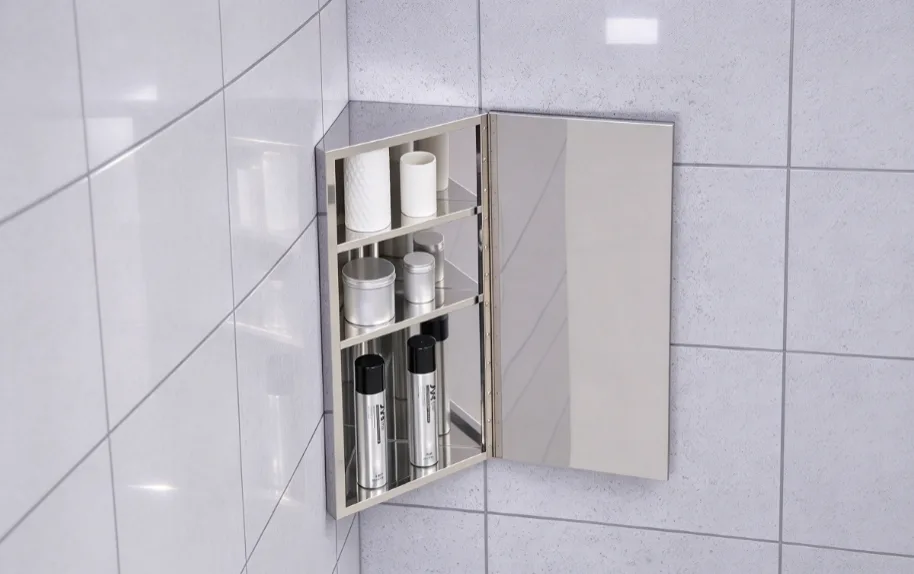
A corner mirror cabinet combines a bathroom mirror with enclosed storage and is designed to make use of the space where two bathroom walls meet. For buyers comparing different cabinet configurations, see our Bathroom Mirror Cabinets collection for recessed, wall-mounted and customized options.
Unlike a conventional mirror cabinet installed on a single flat wall, a corner configuration can potentially use a part of the bathroom that is otherwise difficult to utilize.
This makes corner mirror cabinets relevant when a project needs to combine:
- Mirror functionality
- Enclosed bathroom storage
- Limited wall space
- Space-efficient bathroom planning
The key advantage is therefore not simply that the cabinet is installed in a corner.
The real question is:
Can the corner provide useful storage without interfering with other bathroom fixtures?
This distinction is particularly important for commercial projects, where every bathroom may have different dimensions and installation conditions.
When Should You Choose a Corner Mirror Cabinet?
A corner mirror cabinet is worth considering when several of the following conditions exist.
Bathroom Condition | Corner Mirror Cabinet? |
Very limited straight wall space | ✓ Worth considering |
Unused accessible corner | ✓ Suitable to evaluate |
Small apartment bathroom | ✓ Often suitable |
Compact hotel bathroom | ✓ Depends on layout |
Bathroom renovation with fixed walls | ✓ Potentially useful |
Need additional enclosed storage | ✓ Worth considering |
Large vanity wall with sufficient space | Usually unnecessary |
Cabinet door would hit another fixture | ✕ Not suitable without redesign |
Corner occupied by plumbing or structural elements | ✕ Requires further assessment |
Project requires the simplest standardized installation | Standard cabinet may be easier |
This provides a better starting point than simply asking whether the bathroom is “small.”
The size of the bathroom is only one factor. The usable wall space is often more important.
Small Apartments and Compact Residential Projects
Small apartments are one of the most relevant applications for corner mirror cabinets.
In a compact bathroom, the main vanity wall may already contain the:
- Basin
- Faucet
- Mirror
- Lighting
- Electrical components
- Other bathroom accessories
Adding a conventional wide mirror cabinet may make the wall crowded or require changes to the existing layout.
An accessible corner may provide another location for integrated storage.
Typical applications include:
- Studio apartments
- Micro-apartments
- Urban apartments
- Compact rental housing
- Small residential developments
For developers, the objective is not simply to save floor space.
A well-planned corner mirror cabinet can potentially provide additional enclosed storage without increasing the overall bathroom footprint.
For large-volume projects, buyers may also consider fully assembled mirror cabinets to reduce on-site assembly requirements and simplify project installation.
Hotels and Hospitality Projects
Hotels are another project type where corner mirror cabinets may be useful.
Compact hotel bathrooms often need to accommodate several functions within a limited footprint:
- Vanity
- Toilet
- Shower
- Mirror
- Lighting
- Guest storage
- Toiletry storage
When the wall above the vanity cannot accommodate a conventional mirror cabinet, a corner configuration may provide another option.
However, hotel buyers should not select a corner cabinet simply because the room is compact.
The project team should check:
- Vanity position
- Shower enclosure
- Door swing
- Cabinet door clearance
- Cleaning access
- Maintenance access
- Mirror viewing angle
For hospitality projects, repeatability is also important.
A cabinet that works in one room type may not work in every room type. Hotels with multiple bathroom layouts may therefore need several cabinet configurations.
Serviced Apartments and Extended-Stay Projects
Serviced apartments combine characteristics of hotels and residential properties.
Because guests may stay for longer periods, practical bathroom storage can become more important.
A corner mirror cabinet can potentially provide storage for:
- Toiletries
- Skincare products
- Shaving accessories
- Personal-care products
- Everyday bathroom supplies
This can be particularly useful when the project wants to create a residential-style bathroom while keeping the overall room footprint compact.
For developers, the important question is:
Can additional usable storage be created without expanding the bathroom or reducing circulation space?
If the answer is yes, a corner configuration may be worth evaluating.
Student Housing and Co-Living Projects
Student accommodation and co-living developments frequently use compact bathroom layouts.
Users still need storage, but available wall space may be limited.
A corner mirror cabinet can combine:
Mirror + enclosed storage + corner space
within one installation.
For large student housing projects, standardization is particularly important.
Procurement teams may need to specify:
- Standard cabinet dimensions
- Mirror configuration
- Shelf arrangement
- LED lighting
- Sensor type
- Electrical specifications
- Surface finish
If multiple room types are involved, OEM/ODM customization can also allow the cabinet to be adapted to different bathroom layouts while maintaining a consistent design language.
Bathroom Renovation Projects
Renovation projects can be particularly suitable for considering corner mirror cabinets because the existing structure is often fixed.
The position of the following elements may already be determined:
- Plumbing
- Electrical wiring
- Windows
- Doors
- Vanity
- Shower enclosure
As a result, simply installing a conventional mirror cabinet may not be possible without modifying the existing layout.
A corner cabinet can provide another option if there is an accessible corner.
However, renovation buyers should measure the actual space before ordering.
Important measurements include:
- Wall-to-wall distance
- Available cabinet depth
- Cabinet height
- Adjacent fixture clearance
- Door-opening area
A product that appears suitable in a product photograph may not work in the actual bathroom.
Space-Constrained Residential and Commercial Projects
Corner mirror cabinets can also be considered for other developments where efficient bathroom planning is important.
Examples include:
- Compact rental housing
- Guesthouses
- Vacation apartments
- Small accommodation projects
- Senior living developments
- Residential renovation programs
- Space-constrained commercial bathrooms
The common factor is not necessarily the building type.
It is the combination of:
limited usable wall space + need for enclosed bathroom storage.
For this reason, B2B buyers should evaluate the actual bathroom layout rather than selecting a cabinet based only on project category.
Custom Residential Projects With Unusual Bathroom Layouts
Custom residential projects can present another application.
Some bathrooms may contain:
- Angled walls
- Narrow vanity areas
- Irregular corners
- Windows above the vanity
- Asymmetrical layouts
- Unusual wall configurations
A standard mirror cabinet may not fit efficiently into these spaces.
OEM/ODM manufacturing can provide more flexibility by allowing project buyers to discuss:
- Custom dimensions
- Cabinet materials
- Door configurations
- LED layouts
- Shelf arrangements
- Sensor options
- Surface finishes
For projects with several bathroom layouts, customization can be more practical than forcing every room to use exactly the same retail cabinet.
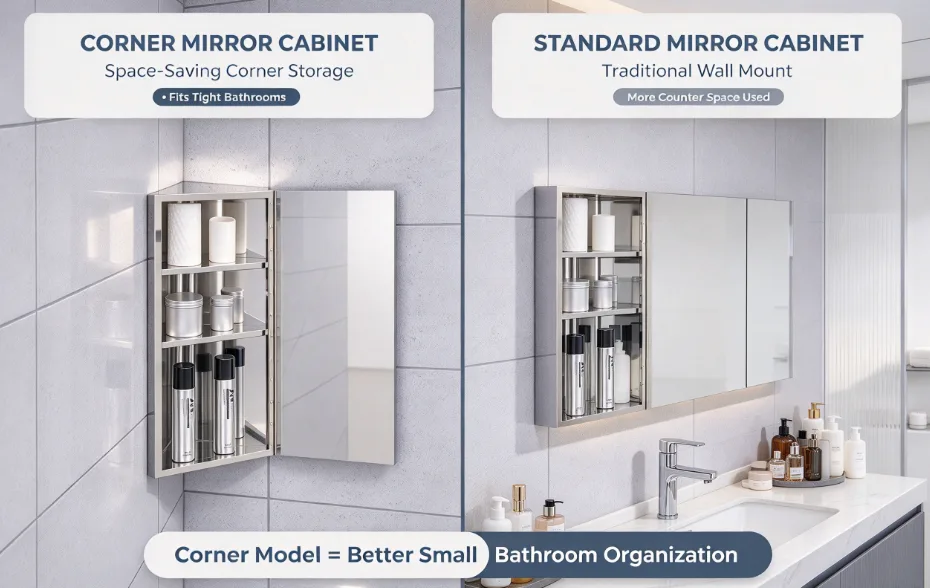
Corner Mirror Cabinet vs. Standard Mirror Cabinet
The right choice depends on the bathroom layout.
Factor | Corner Mirror Cabinet | Standard Mirror Cabinet |
Wall utilization | Uses an accessible corner | Uses straight wall space |
Small bathrooms | Potentially useful | Depends on wall width |
Unused corner | Can make use of it | Usually does not |
Installation | More layout-sensitive | Generally simpler |
Door clearance | Needs careful checking | Usually easier |
Standardization | Requires layout validation | Often easier |
Renovation | Can address some fixed-layout constraints | Depends on existing wall |
Large bathroom | May be unnecessary | Often more flexible |
Storage | Depends on cabinet design | Generally straightforward |
Project customization | Useful for unusual layouts | Also possible |
Neither configuration is universally better.
The correct choice depends on where the usable space is located in the bathroom.
How to Choose a Corner Mirror Cabinet for a Project
For B2B buyers, seven factors should be reviewed before approving a product.
- Corner Dimensions
Measure the actual usable corner.
Confirm:
- Wall-to-wall dimension
- Cabinet width
- Cabinet height
- Cabinet projection
- Installation depth
Do not rely only on the overall bathroom size.
- Door Clearance
Check the complete door-opening area.
The cabinet door should not interfere with:
- Shower doors
- Bathroom doors
- Faucets
- Lighting
- Adjacent cabinets
- Other fixtures
This is one of the most important checks for corner installations.
- Installation Method
Determine whether the project requires:
- Recessed installation
- Surface mounting
- Semi-recessed installation
- Custom installation
For renovation projects, surface-mounted solutions may sometimes reduce the amount of wall modification required.
- Electrical Requirements
For LED mirror cabinets, confirm the electrical requirements before production.If the project also requires integrated lighting, buyers can explore Aosmay’s LED bathroom mirrors for different lighting and sensor configurations.
Depending on the destination market and project specifications, this may include:
- Voltage
- Plug type
- Lighting configuration
- Sensor configuration
- Applicable certification requirements
For international projects, electrical specifications should be confirmed according to the destination market rather than assumed to be universal.
- Internal Storage
External dimensions do not tell the whole story.
Two cabinets with similar external dimensions can provide different amounts of usable storage depending on their internal structure.
For projects where storage is a major selling point, buyers should check:
- Shelf arrangement
- Internal usable depth
- Structural components
- Door opening
- Available storage volume
At Aosmay, the design focus for selected mirror cabinets includes 100% pure storage space, avoiding unnecessary unauthorized structural columns that occupy the usable interior.
- Cabinet Material
Depending on the project requirements, cabinet bodies may use:
- Anodized aluminum
- Powder-coated iron
- Stainless steel
Material selection should consider the intended environment, finish requirements, project budget and durability expectations.
- Packaging and Certification
For international B2B projects, the product specification is only part of the procurement decision.
Buyers should also confirm:
- Applicable product certifications
- Electrical requirements
- Export packaging
- Transportation protection
- Drop-test requirements
- Replacement parts and after-sales support
For large projects, these details should ideally be confirmed before mass production.
For products shipped internationally, buyers can also review ISTA‘s packaging and transport testing standards when evaluating packaging requirements.
Corner Mirror Cabinet Project Checklist
Before placing a bulk order, use this simple checklist:
☐ Is straight wall space limited?
☐ Is there an accessible corner?
☐ Is the corner free from plumbing or structural obstacles?
☐ Can the cabinet door open completely?
☐ Is the cabinet depth compatible with the bathroom layout?
☐ Does the project require additional enclosed storage?
☐ Is recessed or surface mounting required?
☐ Are the electrical specifications confirmed?
☐ Are the required certifications confirmed?
☐ Has the actual installation layout been reviewed before bulk production?
If several answers are unclear, the project should be reviewed before the cabinet is standardized.
Frequently Asked Questions
Are corner mirror cabinets good for small bathrooms?
They can be useful when a small bathroom has limited straight wall space but an accessible corner. However, a small bathroom does not automatically require a corner mirror cabinet. The actual layout should determine the choice.
What type of bathroom needs a corner mirror cabinet?
Bathrooms with limited vanity-wall space, unused corners or fixed renovation layouts are common situations where a corner mirror cabinet may be worth considering.
Are corner mirror cabinets suitable for hotels?
Yes, they can be considered for compact hotel bathrooms, particularly when the vanity wall has limited space. Door clearance, maintenance access and room standardization should be checked before specification.
Can a corner mirror cabinet save bathroom space?
It can make use of an otherwise underutilized corner, potentially creating additional storage without increasing the bathroom footprint. The actual space benefit depends on the layout.
What should I measure before installing a corner mirror cabinet?
Measure the available corner width, cabinet height and depth, adjacent wall clearance, door-opening area and the position of nearby fixtures.
What is the difference between a corner mirror cabinet and a standard medicine cabinet?
A corner mirror cabinet is designed around a wall-corner installation, while a standard medicine cabinet is normally installed against a straight wall. Corner configurations can be useful when straight wall space is limited.
Are corner mirror cabinets suitable for bathroom renovations?
They can be, especially when existing walls, plumbing or fixtures make conventional cabinet installation difficult. The actual corner dimensions and installation conditions should be checked first.
Can corner mirror cabinets be customized for apartment projects?
OEM/ODM manufacturers can discuss customization of dimensions, materials, lighting, storage configuration, finishes and other specifications depending on project requirements.
Final Takeaway
Corner mirror cabinets are not simply a smaller version of a standard bathroom mirror cabinet. They are a layout-driven solution for projects where wall space, storage and bathroom geometry need to work together.
They are particularly worth evaluating for:
- Compact apartments
- Hotels
- Serviced apartments
- Student housing
- Bathroom renovation projects
- Space-constrained residential developments
- Custom residential and commercial projects
For B2B buyers, the most important question is not:
“Is this bathroom small?”
For examples of how bathroom mirror solutions are applied in commercial and residential developments, visit our bathroom projects page.
It is:
“Where is the most usable space for the mirror and enclosed storage?”
If the project has limited straight wall space and an accessible corner, a corner mirror cabinet may provide a practical alternative to a conventional cabinet.
For OEM/ODM projects, Aosmay can support customization of cabinet dimensions, materials, LED configurations, sensor options, storage layouts and finishes according to project requirements.
Aosmay also provides free design services for project buyers who need help evaluating mirror cabinet layouts and OEM/ODM specifications.