
Quick Answer
Choosing an accessible bathroom mirror is not simply about selecting a larger mirror. For hotels, apartments, senior living facilities, healthcare environments and other commercial projects, buyers should evaluate the mirror’s viewing position, installation height, angle, reflective area, lighting, anti-fog performance, electrical safety and applicable accessibility requirements.
For U.S. projects, an ADA bathroom mirror must be considered as part of the overall accessible bathroom installation. Under Section 603.3 of the 2010 ADA Standards, mirrors above lavatories or countertops have a maximum 40-inch height for the bottom edge of the reflecting surface; mirrors not above lavatories or countertops have a maximum 35-inch bottom edge. The standard also provides advisory guidance that a full-length mirror can accommodate more users, with the top edge recommended at least 74 inches above the floor.
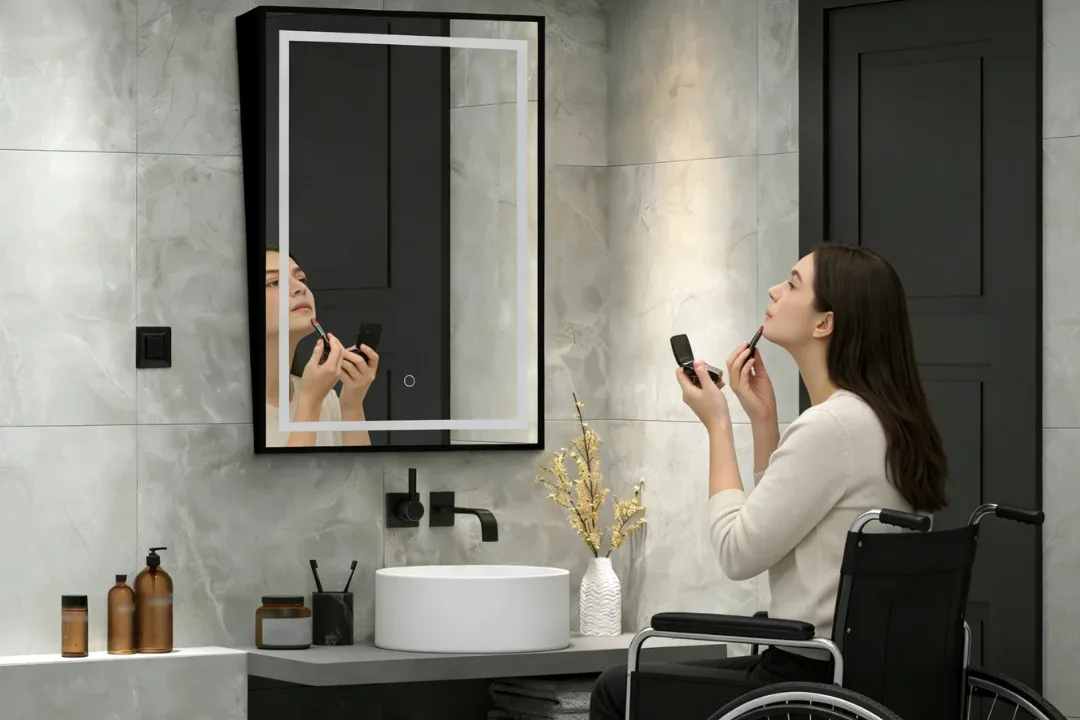
A tilted mirror can be useful when a project needs to accommodate different viewing positions, including seated users. However, a tilted design alone does not automatically make a mirror ADA compliant.
For projects that combine accessibility requirements with contemporary interior design, a black framed mirror can provide a modern appearance while the mirror’s dimensions, angle and installation configuration are developed around the project’s requirements.
Aosmay’s 24 × 39 Inch Black Framed Mirror Bathroom with Tilted Angle combines a tilted rectangular design, integrated LED lighting and anti-fog functionality, making it a product configuration worth evaluating for hotel, apartment and commercial bathroom projects.
- Important: Accessibility requirements vary according to jurisdiction, building type, project scope and installation conditions. Product selection should be verified against the requirements applicable to the specific project before final specification.
What Is an Accessible Bathroom Mirror?
An accessible bathroom mirror is a mirror selected and installed so that people with different heights, mobility levels and seating positions can use it effectively.
A conventional bathroom mirror is often designed around a standing user. An accessible bathroom, however, may need to accommodate:
- Wheelchair users
- People using mobility aids
- Seated users
- People with limited standing ability
- Children or shorter users
- Hotel guests with different physical needs
This changes the way a mirror should be specified.
Instead of asking only:
“How large is the mirror?”
project buyers should ask:
“Can the intended users see themselves clearly from their normal position?”
This makes the relationship between the mirror, user position, mounting height, angle and surrounding bathroom fixtures more important than mirror size alone.
What Should You Consider When Choosing an Accessible Bathroom Mirror?
For commercial and project purchasing, an accessible mirror should be evaluated across several factors rather than one specification.
Selection Factor | Why It Matters | What Buyers Should Check |
Mirror angle | Helps accommodate different viewing positions | Fixed or adjustable tilt |
Mirror size | Determines the available viewing area | Width, height and usable glass area |
Installation height | Affects accessibility for seated and standing users | Project-specific mounting dimensions |
Lighting | Improves facial visibility in bathrooms | LED brightness and light distribution |
Anti-fog | Maintains visibility in humid environments | Anti-fog function and control |
Frame/material | Affects durability and appearance | Aluminum, stainless steel or coated metal |
Electrical safety | Important for illuminated mirrors | Applicable electrical certification |
Bathroom protection | Protects electrical components from moisture | IP rating appropriate to installation |
Maintenance | Important for commercial properties | Cleaning, replacement and serviceability |
Project customization | Different projects have different requirements | Size, lighting and control options |
For a B2B project, these specifications should ideally be confirmed before the product is added to the project specification sheet.
For projects that require both reflection and integrated storage, buyers can also compare these requirements with Aosmay’s LED mirror cabinet solutions.
Why Mirror Angle Matters for Wheelchair Users
A major consideration when selecting an accessible bathroom mirror is the user’s eye level.
A standing user and a wheelchair user may approach the same mirror from significantly different positions.
A conventional vertical mirror can work well for a standing user, but the reflective surface may be less convenient for a seated user depending on the installation height and surrounding layout.
A tilted bathroom mirror changes the angle between the reflective surface and the user’s line of sight.
This can make a tilted configuration worth considering when designing bathrooms for different user positions.
However, the angle should never be evaluated independently.
The final result depends on:
- Mirror dimensions
- Mirror mounting height
- Tilt angle
- Distance between the user and mirror
- Lavatory position
- Clear floor space
- Other bathroom fixtures
- Applicable accessibility requirements
Therefore, a project should specify the mirror together with its intended installation configuration.
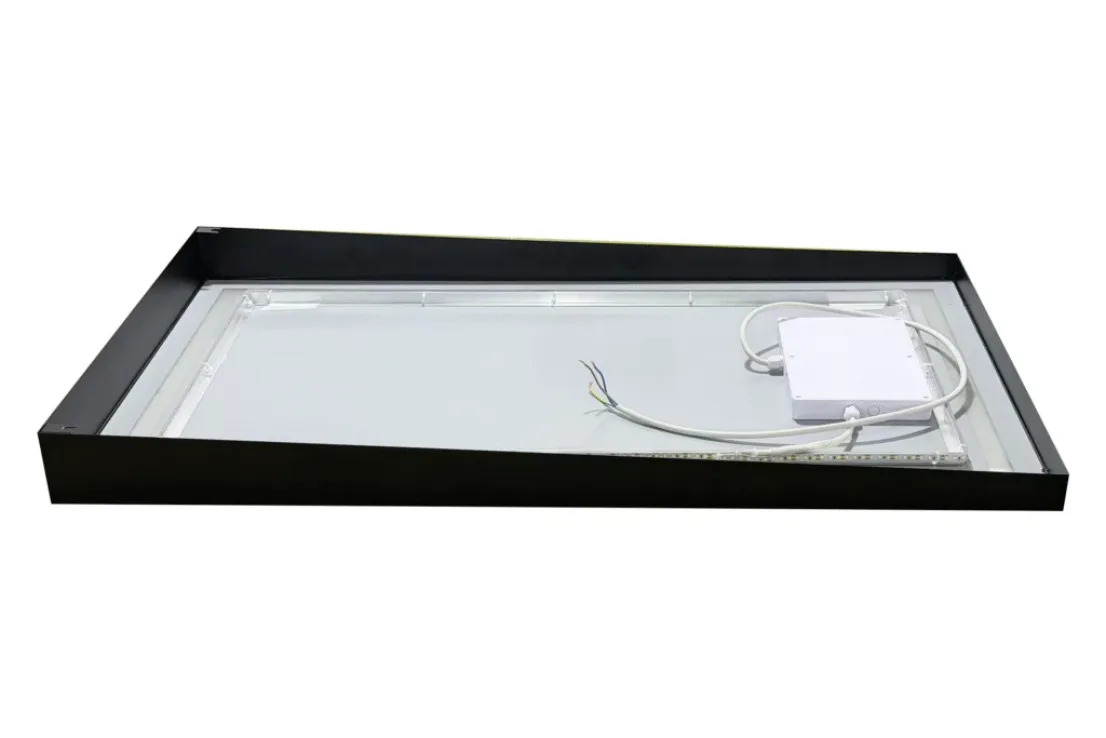
ADA Bathroom Mirror Requirements: What Buyers Should Verify
The term ADA bathroom mirror is commonly used when discussing accessible commercial bathrooms in the United States.
The official 2010 ADA Standards include a specific requirement for mirrors in Section 603.3.
For mirrors located above lavatories or countertops, the bottom edge of the reflecting surface must be no more than 40 inches above the finished floor or ground.
For mirrors not located above lavatories or countertops, the bottom edge of the reflecting surface must be no more than 35 inches above the finished floor or ground.
The same section provides advisory guidance for a full-length mirror. It notes that a single full-length mirror can accommodate a greater number of users, and recommends that the top edge be at least 74 inches above the floor so the mirror can be usable by both ambulatory people and people who use wheelchairs. This is advisory guidance rather than the mandatory dimensional requirement in Section 603.3.
Why does this distinction matter?
Because an ADA bathroom mirror is not simply a product category.
A mirror’s compliance depends on how it is installed as part of the bathroom.
Therefore, a supplier should avoid claiming:
“This tilted mirror is automatically ADA compliant.”
A more technically accurate approach is:
“This mirror can be specified and installed for accessible bathroom applications, subject to project-specific ADA requirements.”
For commercial projects, architects and contractors should verify the complete installation against the applicable edition and requirements.
Official 2010 ADA Standards for Accessible Design
Accessible Bathroom Mirror Standards Around the World
Accessibility requirements are not identical worldwide.
A project buyer sourcing mirrors internationally should therefore avoid treating ADA requirements as a universal global standard.
Market | Relevant Framework | Procurement Consideration |
United States | ADA Standards | Verify mirror installation and accessible bathroom requirements |
United Kingdom | Check applicable building accessibility guidance | |
Australia | NCC + Premises Standards / AS 1428.1 | Confirm current applicable provisions |
Europe | National building/accessibility requirements | Verify requirements in the project country |
In the United Kingdom, Approved Document M provides statutory guidance relating to access to and use of buildings and their facilities. The current GOV.UK publication includes separate volumes for dwellings and buildings other than dwellings.
In Australia, the Australian Building Codes Board states that the amended Premises Standards took effect on July 29, 2025, with the updated framework referencing AS 1428.1:2021.
The practical lesson for global B2B buyers is simple:
Specify the target market first, then confirm the applicable accessibility standard before finalizing the mirror configuration.
This is especially important for OEM/ODM projects because the same mirror may be sold into different countries with different installation requirements.
Does a Larger Mirror Make a Better Accessible Bathroom Mirror?
Not necessarily.
A larger mirror provides more reflective area, but size alone does not determine accessibility.
Consider two mirrors with the same height.
If one is installed too high, the additional reflective area may not be useful to a seated user.
This means buyers should distinguish between:
Overall mirror size
and
usable viewing area from the intended user position.
For many commercial projects, a vertical rectangular mirror can provide useful coverage while maintaining an efficient wall footprint.For projects comparing different LED mirror formats, see Aosmay’s LED bathroom mirror collection.
Aosmay’s 24 × 39 Inch Black Framed Mirror Bathroom follows this format.
The 24 × 39 inch size can be evaluated for:
- Hotel bathrooms
- Apartment developments
- Accessible residential bathrooms
- Senior living projects
- Hospitality renovations
- Commercial bathrooms
- Multi-unit developments
The final mounting position should still be determined from the project drawings and applicable requirements.
Can a Black Framed Mirror Be Used in an Accessible Bathroom?
Yes.
Accessibility does not mean that a bathroom must look institutional.
A black framed mirror can provide a contemporary visual style while accessibility is addressed through the mirror’s dimensions, installation position and functional configuration.
Black frames can work particularly well with:
- Matte black faucets
- Black shower hardware
- Dark bathroom accessories
- White or light-colored walls
- Modern hotel interiors
- Contemporary apartment bathrooms
For architects and developers, this can help maintain a consistent design language between accessible and standard bathroom rooms.
The important distinction is:
The black frame is a design choice.
The accessibility configuration is a functional and compliance consideration.
Keeping these two factors separate makes product specification clearer.
Tilted vs Fixed vs Adjustable Bathroom Mirrors
Different projects may require different mirror configurations.
Mirror Configuration | Potential Application | Main Consideration |
Fixed vertical mirror | Standard bathroom layouts | Installation position is critical |
Fixed tilted mirror | Projects requiring a different viewing angle | Angle must be specified correctly |
Adjustable tilt mirror | Users with significantly different viewing positions | More mechanical components |
Full-length mirror | Projects serving multiple user heights | Requires appropriate wall space and installation |
A fixed tilted mirror can provide a relatively simple product configuration while creating a different viewing angle.
An adjustable mirror can provide greater flexibility but may involve additional components and a different cost structure.
For hotel and apartment projects, the appropriate choice should be based on the project’s user requirements rather than assuming that one mirror type works for every installation.
Example: Aosmay 24 × 39 Inch Tilted Black Framed Mirror
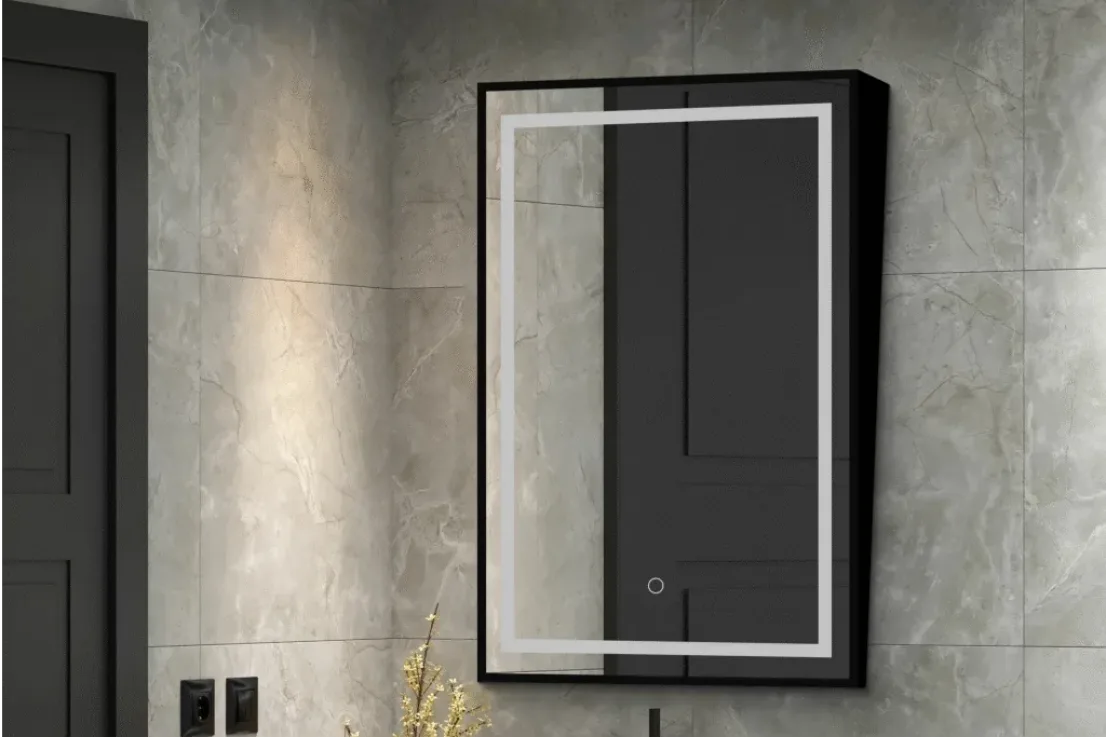
Aosmay’s 24 × 39 Inch Black Framed Mirror Bathroom with Tilted Angle provides an example of how product design can address several project requirements simultaneously.
Tilted Rectangle Design
The angled reflective surface changes the viewing geometry compared with a conventional flat vertical mirror.
This configuration can be evaluated for projects where seated users require a different viewing position.
Integrated LED Lighting
Built-in LED lighting combines illumination with the reflective surface, helping create a coordinated bathroom fixture.
Anti-Fog Function
The anti-fog design helps maintain mirror visibility in humid bathroom environments.
Black Frame
The black frame provides a contemporary finish suitable for modern hospitality and residential interiors.
24 × 39 Inch Format
The rectangular format provides a substantial vertical reflective surface without requiring an excessively wide wall footprint.
Project Applications
The mirror can be evaluated for:
- Hotels
- Apartments
- Accessible residential bathrooms
- Senior living developments
- Hospitality projects
- Commercial renovations
- Multi-unit housing
- OEM/ODM project orders
Importantly, the product should not be treated as automatically ADA compliant simply because it has a tilted design. The final installation configuration should be reviewed against the project’s applicable accessibility requirements.
Accessible Bathroom Mirror Specification Checklist
Before approving a mirror for a commercial project, buyers can use the following checklist.
Accessibility
- What type of users will use the bathroom?
- Is the mirror intended for seated and standing users?
- Is a tilted or adjustable configuration required?
- What mounting height is specified?
- What accessibility standard applies?
Mirror
- What are the required dimensions?
- What is the usable reflective area?
- Is a black framed mirror preferred?
- Is a full-length mirror required?
Lighting
- Is integrated LED lighting required?
- What color temperature is preferred?
- What brightness level is required?
- Is dimming or sensor control needed?
Bathroom Environment
- Is anti-fog required?
- What IP protection is required?
- What frame material is appropriate?
- What cleaning and maintenance conditions apply?
Electrical
- What voltage and frequency are required?
- What plug or wiring configuration is required?
- What certifications are required for the destination market?
Procurement
- What quantity is required?
- Is OEM/ODM customization required?
- Is a sample required?
- Are installation drawings required?
- What packaging specification is required?
- What warranty and spare-parts support are required?
This checklist allows architects, contractors and procurement teams to convert a general “accessible bathroom” requirement into a specific mirror specification.
Accessible Bathroom Mirror for Hotels and Apartment Projects
For hotel and apartment developments, mirror selection is rarely just about one bathroom.
A project may require the same mirror specification across multiple rooms.
This creates several additional procurement considerations.
Consistent Design
A black framed mirror can create a consistent visual style across standard and accessible rooms.
Repeatable Installation
A clearly defined mounting configuration can simplify installation across multiple units.
Functional Features
Integrated LED lighting and anti-fog functionality can reduce the need for separate bathroom components.
OEM/ODM Flexibility
Large projects may require customized dimensions, finishes, lighting configurations or electrical specifications.
Packaging
Mirrors are vulnerable during transportation, so packaging should be considered as part of the procurement specification rather than as an afterthought.
For B2B buyers, the goal is therefore not simply to purchase an accessible mirror.
It is to establish a repeatable product specification that can be manufactured, packaged, installed and serviced consistently across the project.
FAQ: Accessible Bathroom Mirror & ADA Bathroom Mirror
What is an accessible bathroom mirror?
An accessible bathroom mirror is a mirror selected and installed to provide practical viewing access for people with different heights, mobility levels and seating positions. Accessibility depends on the complete installation, not simply on the mirror itself.
What makes an ADA bathroom mirror different?
An ADA bathroom mirror is typically specified as part of an accessible bathroom installation in the United States. Section 603.3 of the 2010 ADA Standards specifies the maximum height of the bottom edge of the reflecting surface for mirrors above lavatories/countertops and for other mirrors.
What height should an ADA bathroom mirror be?
For mirrors above lavatories or countertops, the 2010 ADA Standards specify that the bottom edge of the reflecting surface must be no more than 40 inches above the finished floor. For mirrors not located above lavatories or countertops, the maximum is 35 inches.
The project should also consider the complete bathroom layout and applicable local requirements.
Is a tilted mirror better for wheelchair users?
A tilted mirror can provide a different viewing angle and may be useful for seated users. However, its suitability depends on the mirror dimensions, installation height, angle, user position and project requirements.
Can a black framed mirror be ADA compliant?
A black frame does not determine ADA compliance. The frame is primarily a design and material specification. Accessibility depends on the mirror’s installation and the applicable requirements.
Are LED bathroom mirrors suitable for accessible bathrooms?
Yes. LED mirrors can be used in accessible bathrooms when the product’s electrical configuration, installation and safety requirements are appropriate for the project.
Why is anti-fog useful for an accessible bathroom mirror?
Anti-fog functionality helps maintain a clearer reflective surface in humid conditions. It can be particularly useful where users may have limited ability to reposition themselves in front of the mirror.
Can an accessible bathroom mirror be customized for hotel projects?
Yes. OEM/ODM manufacturers can evaluate customized dimensions, frame finishes, lighting configurations, controls, electrical specifications and packaging requirements according to the project.
Final Takeaway
Choosing an accessible bathroom mirror is a specification exercise, not simply a product selection exercise.
For commercial projects, buyers should evaluate:
User position → mirror dimensions → installation height → mirror angle → viewing area → lighting → anti-fog → electrical requirements → applicable accessibility standards.
For U.S. projects, the ADA bathroom mirror requirements should be verified against the applicable ADA Standards and the complete bathroom installation. For international projects, buyers should confirm the accessibility framework applicable to the destination market rather than assuming that ADA requirements apply globally.
A black framed mirror can then provide the desired contemporary appearance without replacing the technical accessibility considerations.
Aosmay’s 24 × 39 Inch Black Framed Mirror Bathroom with Tilted Angle combines a tilted rectangular design, integrated LED lighting and anti-fog functionality, providing a practical configuration for evaluation in hotel, apartment, hospitality and commercial bathroom projects.
For OEM/ODM requirements, Aosmay provides free design services to help project buyers evaluate mirror dimensions, frame finishes, lighting configurations and other product specifications before production.