
Quick Answer
Bathroom mirror cabinet installation requirements vary by market. In the US, projects commonly require attention to applicable electrical codes, GFCI protection and product safety requirements. European projects need to consider bathroom zones together with applicable EU product legislation and national or local installation rules. Australia follows AS/NZS 3000 and its bathroom-zone requirements.
For B2B buyers, the key checks are installation location, IP rating, electrical connection, product conformity, mounting requirements and local installation rules.
The same LED bathroom mirror cabinet should not automatically be treated as compliant for every market. Before ordering, wholesalers, distributors, contractors and project buyers should confirm the destination market, installation location, electrical configuration, required protection level and compliance documentation.
For OEM/ODM projects, these requirements should be confirmed during product development and sampling—not after mass production has started.
1. Why Do Bathroom Mirror Cabinet Standards Differ by Region?
A bathroom mirror cabinet combines several product functions in one unit:
- Mirror and cabinet structure
- LED lighting
- Electrical components
- Switches or touchless sensors
- Power outlets or shaver sockets
- Anti-fog heating
- Internal wiring
- Wall mounting hardware
The cabinet may look like a piece of bathroom furniture, but integrating electrical components introduces additional product and installation considerations.
Once a cabinet includes LED lighting, electrical outlets, anti-fog heating, touch or touchless sensors, Bluetooth functions or internal wiring, buyers need to consider both the physical bathroom environment and the electrical requirements applicable to the product and installation.
This is particularly important for hotels, apartments, residential developments and commercial projects, where the same mirror cabinet specification may be repeated across dozens or hundreds of bathrooms.
The key point is that product compliance and installation compliance are related but are not the same thing.
A product may have an appropriate enclosure rating and electrical design, but the final installation must still comply with the requirements applicable to the project location.
For buyers comparing cabinet construction, materials and moisture resistance, see our guide to [bathroom mirror cabinet surface treatments].
2. Why Electrical Integration Changes the Requirements
An LED bathroom mirror cabinet is more than a mirror with a light.
Depending on the configuration, it may contain:
- LED modules
- LED drivers
- Touch or touchless sensors
- Anti-fog heating elements
- Internal sockets
- Bluetooth modules
- Switches
- Wiring and connectors
Each additional electrical function can affect the product specification, testing, electrical configuration or installation requirements.
For example, a cabinet designed for a US project may require a different electrical configuration from one designed for Australia. A European project may also require different product documentation and conformity information from a US project.
Therefore, the target market should be identified before the OEM sample is finalized.
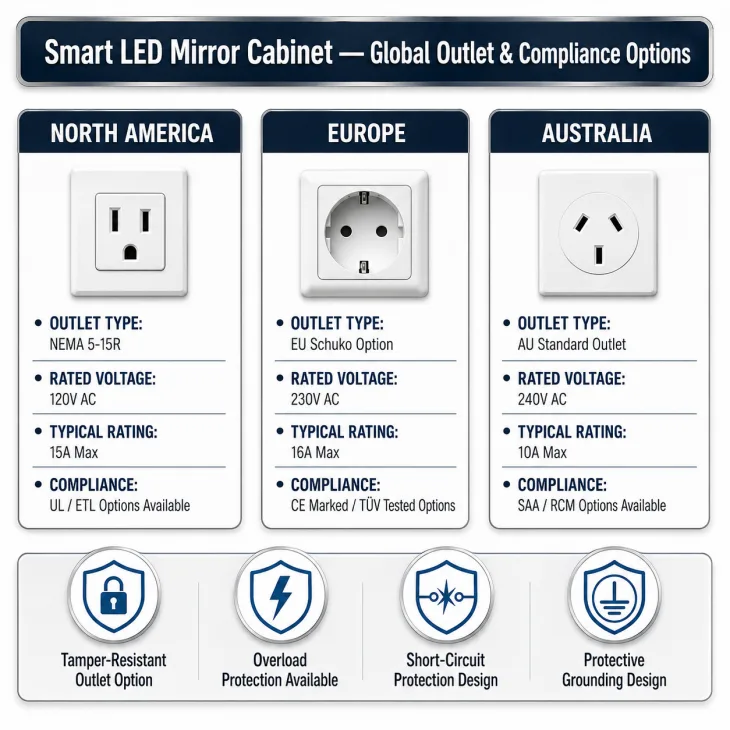
3. US: Electrical Codes, GFCI and Product Safety
For US projects, bathroom mirror cabinet installation requirements are determined by the applicable electrical code, product requirements and local jurisdiction.
The National Electrical Code (NEC) contains GFCI requirements for specified receptacles and locations. For example, NEC provisions address GFCI protection for receptacles in bathrooms and other specified locations.
For a powered bathroom mirror cabinet, buyers should therefore check:
Procurement Item | US Consideration |
Electrical protection | Check applicable local electrical code and GFCI requirements |
Product certification | Confirm the certification or evaluation appropriate to the product and market |
Installation | Follow manufacturer instructions and applicable local electrical code |
Power connection | Confirm plug, hardwire or other specified configuration |
Bathroom location | Confirm the distance from showers, baths and other wet areas |
IP protection | Select according to the actual product and installation environment |
Documentation | Request relevant certification and installation documentation |
UL 962 and Electrified Bathroom Cabinets
UL 962 is a relevant North American safety standard for certain household and commercial furnishings. Its scope includes built-in bathroom cabinets rated up to 600 V AC, as well as other electrified furnishings. The standard addresses areas such as electrical safety, mechanical strength and other product safety considerations.
However, buyers should not treat “UL” as a generic marketing label.
The applicable certification or evaluation depends on the actual product configuration, electrical components and intended use. A B2B buyer should verify that the specific model and configuration being ordered are covered by the applicable certification or evaluation.
This is particularly important when an OEM supplier offers different combinations of:
- LED lighting
- Internal outlets
- Anti-fog heating
- Sensors
- Voltage options
- Plug configurations
Changing the electrical configuration can affect the applicable compliance requirements.
4. Europe: Bathroom Zones and EU Product Compliance
European bathroom installations commonly use electrical zones around baths and showers. IEC 60364-7-701:2019 provides specific requirements for electrical installations in locations containing baths or showers and describes the relevant zones. The 2019 edition replaced the previous 2006 edition and revised the description of the zones.
However, Europe should not be treated as having one single installation rule.
IEC-based requirements provide an important technical framework, while the actual installation requirements may also depend on the national or local rules adopted in the destination country.
For an LED bathroom mirror cabinet, buyers should consider:
- Distance from the bath or shower
- Installation zone
- Required IP protection
- Electrical connection method
- Product standard and conformity requirements
- Local electrical installation rules
- Installation instructions
Product Compliance vs. Installation Compliance
One of the most important distinctions for European projects is the difference between product compliance and installation compliance.
Product compliance concerns whether the electrical product meets the applicable legislation and conformity requirements for being placed on the market.
Installation compliance concerns whether the product is installed correctly at the project location.
For electrical equipment within the scope of the EU Low Voltage Directive, manufacturers are required to carry out the applicable conformity assessment, prepare technical documentation and, where the Directive applies, draw up an EU Declaration of Conformity and affix the CE marking after demonstrating compliance.
The EU Declaration of Conformity identifies the product and the applicable Union legislation and standards. It is therefore more useful for procurement verification than simply checking whether a CE mark appears on a product.
For European buyers, the procurement checklist should therefore include:
- Applicable EU legislation
- CE marking where required
- EU Declaration of Conformity
- Technical documentation where appropriate
- Applicable harmonised standards
- Installation instructions
- National or local installation requirements
CE marking should not be treated as a universal “bathroom certification.” It addresses applicable EU product legislation; the final bathroom installation still needs to comply with the rules applicable at the project location.
5. Australia: AS/NZS 3000 and Bathroom Electrical Zones
Australia uses AS/NZS 3000, commonly known as the Wiring Rules, as the key framework for electrical installations. Standards Australia describes AS/NZS 3000:2018 as the rules used by electricians to design, construct and verify electrical installations, including the selection and installation of electrical equipment.
Bathroom mirror cabinets therefore need to be considered in relation to their installation location and electrical configuration.
Australian requirements should not be reduced to simply: Type I plug + IP rating
The installation location, electrical accessories, protective measures, clearances and product configuration also need to be considered.
For example, NSW Government guidance referencing AS/NZS 3000:2018 identifies minimum IPX4 protection requirements for certain switches installed in Zone 2 wet areas and highlights clearance requirements for switches and socket outlets.
For an Australian mirror cabinet project, buyers should confirm:
- The intended bathroom zone.
- The required IP protection.
- The electrical connection method.
- Whether the cabinet contains a socket or other accessory.
- Applicable RCD and other protective requirements.
- Whether electrical installation must be performed by a licensed practitioner.
- Whether the supplied documentation matches the Australian product configuration.
Electrical work in Australia is subject to state and territory requirements, and Standards Australia advises users to consult the relevant electrical safety regulator for mandatory installation requirements.
6. Installation Requirements vs. Product Requirements
One of the most important concepts for international bathroom mirror cabinet procurement is the difference between installation requirements and product requirements.
Installation requirements determine:
- Where the cabinet can be installed
- Required clearances
- Bathroom zone
- Electrical connection method
- Protective devices
- Local wiring requirements
- Installer requirements
Product requirements determine:
- Electrical design
- Enclosure protection
- Electrical components
- Product configuration
- Applicable testing or certification
- Compliance documentation
- Installation instructions
These two areas are connected, but they are not interchangeable.
For example, an IP-rated cabinet does not automatically become compliant simply because it has the required IP rating.
Similarly, a cabinet with an appropriate certification does not automatically mean that it can be installed in every location within a bathroom.
The product specification and installation environment must be considered together.
7. US vs. Europe vs. Australia: What Should B2B Buyers Compare?
Instead of looking for one universal “bathroom mirror cabinet standard,” international buyers should compare the specific procurement requirements for the destination market.
Procurement Check | US | Europe | Australia |
Main installation framework | NEC + applicable local codes | IEC-based requirements + national/local rules | AS/NZS 3000 + applicable local requirements |
Bathroom zones | Depends on applicable code | IEC-based bathroom zones | Defined bathroom zones |
Ground-fault protection | GFCI where required | RCD/protective measures as applicable | RCD/protective measures as applicable |
IP protection | Depends on product and installation location | Depends on zone and applicable rules | Depends on zone and equipment |
Product conformity | Applicable North American certification/evaluation | CE + applicable EU legislation | Applicable Australian requirements |
Electrical connection | Plug or hardwire depending on product and code | Market-specific | Market-specific |
Installation | Local code and jurisdiction | National/local installation rules | Local rules and licensed electrical work where applicable |
Documentation | Certification + installation instructions | DoC + technical documentation + instructions | Product documentation + installation instructions |
OEM customization | Electrical configuration must match destination | Product compliance and configuration must match destination | Configuration must match applicable AS/NZS requirements |
The comparison shows why a single global specification may not be appropriate for every market.
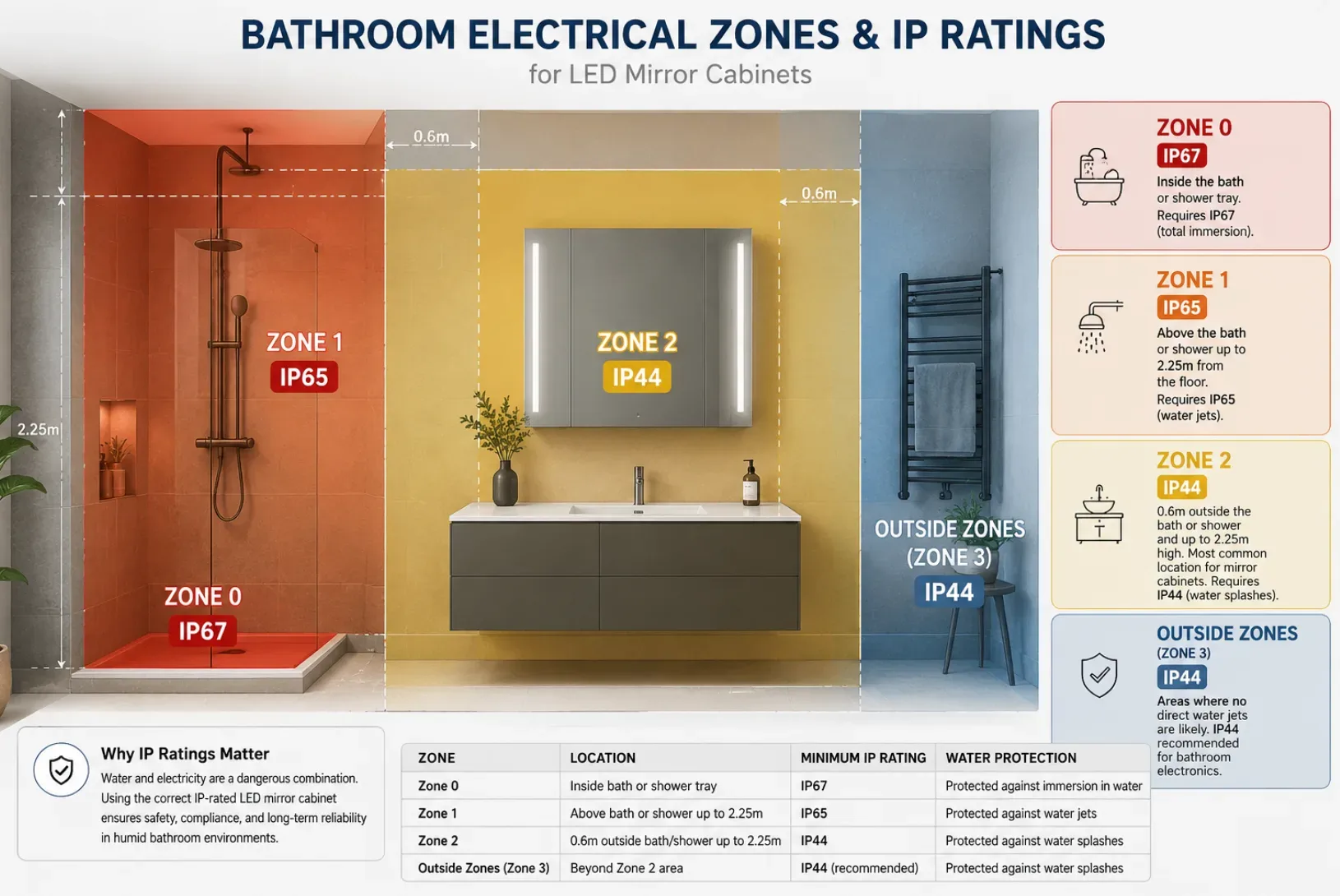
8. How Does IP Rating Affect Bathroom Mirror Cabinet Installation?
IP rating is one part of the installation decision, but it should not be used on its own to determine whether a bathroom mirror cabinet is suitable for a specific location.
The IEC 60529 IP Code classifies the degree of protection provided by enclosures against ingress of solids and water.
For bathroom mirror cabinets, IP44 and IP65 are common specifications, but the appropriate level depends on the product design, installation environment and applicable requirements.
IP Rating | General Protection | Procurement Consideration |
IP44 | Protection against objects above 1 mm and splashing water | May be suitable for certain bathroom locations when permitted by the applicable requirements |
IP65 | Dust-tight and protected against water jets | May be specified where greater water-jet protection is required |
The correct question is therefore not:
“Is IP65 always better than IP44?”
It is:
“What level of enclosure protection is required for this product in its intended installation environment?”
For a detailed explanation of IP44, IP65 and bathroom electrical zones, see our guide to LED bathroom mirror cabinet IP ratings.
9. What Should B2B Buyers Confirm Before Ordering?
Before approving an OEM/ODM bathroom mirror cabinet for mass production, buyers should confirm the following seven areas.
Destination Market
Identify the actual destination market before finalizing the electrical configuration.
For example:
- US
- Germany
- France
- UK
- Australia
- New Zealand
- Other target markets
Different markets may require different electrical configurations and documentation.
Installation Location
Define where the cabinet will be installed.
For example:
- Above a bathroom vanity
- Near a shower
- Near a bathtub
- Within a defined bathroom zone
- In a hotel bathroom
- In a multi-unit residential bathroom
The installation location can affect the applicable electrical and IP requirements.
Electrical Configuration
Confirm:
- Voltage
- Frequency
- Plug type
- Hardwire configuration
- Internal socket requirements
- LED driver specification
- Sensor configuration
- Anti-fog heating
- Other powered functions
This information should be included in the product specification before sampling.
IP Protection
Confirm the required enclosure protection based on the intended installation environment.
Do not select IP65 simply because it has a higher number.
Instead, determine the applicable requirement from:
installation location + product design + electrical components + local requirements.
Product Conformity
Ask the manufacturer which conformity documents apply to the exact product configuration.
Depending on the market, this may involve:
- Certification or third-party evaluation
- CE marking
- EU Declaration of Conformity
- Technical documentation
- Applicable national requirements
- Test reports
- Product-specific compliance information
The documentation should correspond to the actual model being purchased.
Installation Documentation
A commercial mirror cabinet should be supplied with appropriate installation information.
Depending on the product, this may include:
- Mounting instructions
- Electrical connection information
- Wiring diagrams
- Product limitations
- Safety warnings
- Recommended installation conditions
- Maintenance instructions
Good documentation helps installers understand how the product is intended to be used.
Final Product Configuration
The final approved sample should match the product that enters mass production.
This is especially important when the same cabinet is offered with different:
- Plug types
- Voltage configurations
- LED systems
- Sensors
- Anti-fog functions
- Internal sockets
- IP configurations
- Cabinet materials
A certification or test report should not automatically be assumed to cover every possible configuration of a product family.
10. How OEM/ODM Manufacturing Can Simplify Regional Compliance
For OEM/ODM projects, regional requirements should be translated into product specifications before sampling and mass production.
This may involve adjusting:
- Cabinet structure
- Electrical configuration
- Plug type
- IP protection
- Lighting functions
- Sensor configuration
- Mounting method
- Cabinet dimensions
- Packaging
- Product documentation
The advantage of OEM/ODM manufacturing is not simply changing the appearance of a mirror cabinet.
The electrical configuration, cabinet structure, mirror size, mounting method and packaging can be considered together for the intended market.
OEM/ODM Engineering Before Mass Production
From an OEM manufacturing perspective, these specifications should be confirmed together rather than separately.
For example, changing the target market may affect the plug or wiring configuration, while changing the installation location may affect the required IP protection or electrical configuration.
Cabinet dimensions, mounting structure and packaging may also need to be considered at the same time.
This is why regional requirements are better defined during the quotation, drawing and sample stages rather than after mass production has started.
11. Aosmay OEM/ODM Mirror Cabinet Configurations
At Aosmay, mirror cabinets can be developed around different market and project requirements, including:
- Aluminum, stainless steel and powder-coated cabinet bodies
- Copper-free eco silver mirrors
- IP44/IP65 configurations
- Type B, F and I plug options
- LED lighting configurations
- Touch and touchless sensor options
- Anti-fog functions
- Customized dimensions
- Fully assembled cabinet construction
For commercial projects, hotels, apartments and multi-unit developments, these specifications can be discussed during the OEM/ODM development stage.
The goal is to define the complete product configuration before mass production rather than treating electrical and installation requirements as an afterthought.
12. FAQ: Bathroom Mirror Cabinet Installation Standards
Can the same LED mirror cabinet be sold in the US, Europe and Australia?
The same basic cabinet design may be adapted for multiple markets, but the electrical configuration, product conformity, plug type, wiring, installation instructions and other specifications may need to change according to the destination market.
The final configuration should be evaluated against the requirements applicable to the target market and installation.
Is IP44 enough for a bathroom mirror cabinet?
It depends on the installation location and applicable requirements.
IP44 may be suitable for certain bathroom locations, but buyers should not treat IP44 as a universal approval for every bathroom installation.
The required protection should be determined from the actual installation environment, product design and applicable local requirements.
For more detail, see our LED bathroom mirror cabinet IP rating guide.
Does an LED bathroom mirror cabinet need GFCI protection in the US?
GFCI requirements apply to specified receptacles and locations under the applicable electrical code. NEC provisions specifically address receptacles in bathrooms and other specified locations.
Whether a particular mirror cabinet requires a specific connection method depends on the product design, electrical configuration and installation location.
The cabinet should therefore be evaluated together with the electrical installation rather than assuming that every internal component requires the same protection.
Does a bathroom mirror cabinet need CE marking in Europe?
If the product falls within EU legislation requiring CE marking, the manufacturer must complete the applicable conformity assessment and meet the relevant requirements before affixing the CE marking. The applicable legislation depends on the product and its characteristics.
CE marking should not be treated as a universal bathroom installation certification.
It concerns applicable EU product legislation, while the final installation must also comply with the rules applicable at the project location.
What IP rating is required in Australian bathroom zones?
The required protection depends on the bathroom zone, equipment and applicable requirements.
AS/NZS 3000 provides the framework for electrical installations in Australia and New Zealand, while state and territory regulators may provide additional guidance for specific installation situations.
For example, NSW guidance referencing AS/NZS 3000:2018 identifies IPX4 requirements for certain switches installed in Zone 2 wet areas.
Therefore, buyers should confirm the actual installation location and product configuration rather than selecting an IP rating solely based on a general bathroom rule.
Does an IP rating replace electrical certification?
No.
An IP rating describes the protection provided by an enclosure against the ingress of solids and water. It does not by itself demonstrate compliance with electrical safety, product certification or local installation requirements.
A compliant bathroom mirror cabinet specification should consider:
IP protection + electrical design + product conformity + installation requirements.
Should an LED mirror cabinet manufacturer provide installation instructions?
Yes.
For electrical bathroom products, installation documentation should clearly identify the intended installation conditions, electrical connection, mounting method, product limitations and relevant safety requirements.
For B2B projects, installation documentation should also match the exact product configuration supplied.
13. Conclusion
Bathroom mirror cabinet installation requirements vary by market, but the procurement decision usually comes down to five connected factors:
installation location + IP protection + electrical configuration + product conformity + local installation requirements.
US projects require attention to applicable electrical codes and GFCI requirements. European projects require consideration of bathroom zones, applicable EU product legislation and national or local installation rules. Australian projects need to account for AS/NZS 3000 and the electrical requirements applicable to the installation location.
For wholesalers, distributors, contractors and project developers, these specifications should be confirmed before the OEM sample is approved and finalized before mass production.
Aosmay is a Foshan bathroom source factory with 27 years of OEM/ODM experience, supplying bathroom mirrors and fully assembled LED mirror cabinets for commercial projects, hotels, developers and B2B brands.
If you already have a project drawing, target market or product specification, Aosmay can provide free design services to help evaluate cabinet dimensions, structure and electrical configuration before production.