
In the North American and European commercial real estate sectors, the evaluation criteria for bathroom architecture have fundamentally shifted. According to market analysis from Grand View Research, the global smart bathroom market is projected to surge to $18.76 billion by 2030, driven heavily by commercial expansions in the hospitality sector. Concurrently, the National Kitchen & Bath Association (NKBA) 2026 Bath Trends Report highlights that modern bathroom designs are increasingly drawing inspiration from luxury hotel environments, prioritizing integrated smart technology and wellness-focused illumination.
This surge in bespoke architectural requirements presents a major obstacle for procurement teams. Navigating the gap between a European designer’s customized, minimalist rendering and an overseas factory’s mass-production line is highly challenging.
For real estate developers, hospitality procurement directors, and international wholesale distributors, entering into a contract with an Aosmay OEM/ODM mirror factory ensures rigorous due diligence is built into the process. Sourcing hundreds of hospitality-grade fixtures from unverified suppliers based on price alone frequently leads to unexpected design modifications, compliance rejections at customs, or premature electrical failure in high-humidity environments.
To secure your supply chain and protect your commercial investment, you must approach your supplier not merely as a vendor, but as a technical engineering partner. Before finalizing a bulk purchase order for Custom LED Bathroom Mirrors, ensure you ask your manufacturer these five precise structural, electrical, and logistical questions.
1. How Does Your Engineering Team Execute DFM for Large-Scale Custom LED Bathroom Mirrors?
A critical point of failure in custom procurement is the absence of a formal Design for Manufacturing (DFM) review. A basic supplier will simply attempt to copy a sketch, whereas an expert engineering factory will systematically deconstruct the drawing to optimize it for long-term structural integrity and safe commercial installation.
When submitting your initial concepts for Custom LED Bathroom Mirrors, ask the manufacturer how they engineer the chassis. In luxury hotels and multi-family developments, oversized double-vanity mirrors are increasingly common. These large glass expanses require a highly rigid back-frame (usually precision-cut anodized aluminum or stainless steel) to prevent the glass from flexing, warping, or distorting reflections over time.

Aosmay 38×30 Inch Stainless Steel LED Mirror with Gold Frame
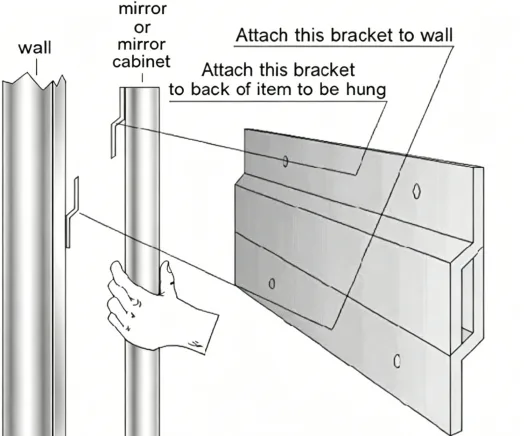
Furthermore, ask about their mounting engineering. Elite manufacturers utilize commercial-grade Z-bar hanging systems rather than basic keyhole slots. A continuous Z-bar system distributes the heavy weight of the mirror evenly across the wall studs, ensuring a rapid, perfectly level installation that meets the strict safety and ADA requirements of North American and European commercial projects.
2. What Technical Safeguards Does an Aosmay OEM/ODM mirror factory Use Against Edge Oxidation?
The ultimate killer of commercial mirror longevity is edge desilvering, commonly known as “black edge.” In a busy hotel or multi-family apartment complex, bathrooms experience prolonged periods of high humidity and exposure to volatile organic compounds (VOCs) from commercial cleaning chemicals. These micro-particles attack the edges of low-grade glass, triggering galvanic corrosion that destroys the silver reflective backing.
You must ask your factory about their glass chemistry and edge-sealing technology:
- The Baseline Standard: The factory must utilize 5mm Copper-Free Silver Glass. By removing the copper layer entirely from the mirror-plating sequence, the raw material becomes exponentially more resistant to humidity-driven oxidation.
- Advanced Sealing Passivation: When working with an Aosmay OEM/ODM mirror factory, a specialized polymer passivation treatment is applied to the freshly cut CNC glass edges. This protective barrier shields the vulnerable silver layer from environmental moisture, drastically extending the operational life of the mirror and maintaining a pristine aesthetic for the lifetime of the hotel room.
3. How Does a Premier LED Bathroom Mirror Manufacturer Manage Light Diffusion?
In luxury European and American interior design, lighting must be seamless. The user interface (UI) and the quality of the illumination are the primary points of interaction for the guest. If the LEDs create harsh shadows or visible “dotted” hotspots, the entire product feels unrefined.
When vetting an LED Bathroom Mirror Manufacturer, demand complete transparency regarding their optical engineering and electronic flexibility:
- Optical Diffusion & Minimalist Aesthetics: Ask how they eliminate LED hotspots. Premium factories utilize advanced acrylic light diffusers and specialized frosted glass sandblasting techniques. This ensures the light is dispersed evenly, delivering a flawless, continuous halo effect that European and American designers demand for high-end projects.
- Customizable UI Logic: In a hospitality environment, a brightly glowing touch button can disturb a guest’s sleep. An expert OEM partner does not force a universal standard; instead, they offer fully customizable UI logic. Whether your hotel brand standard requires a specific dimming curve, a “stealth mode” where the standby indicator turns off completely in the dark, or specific color indicators, a true manufacturer engineers the capacitive touch software to match your exact project requirements.
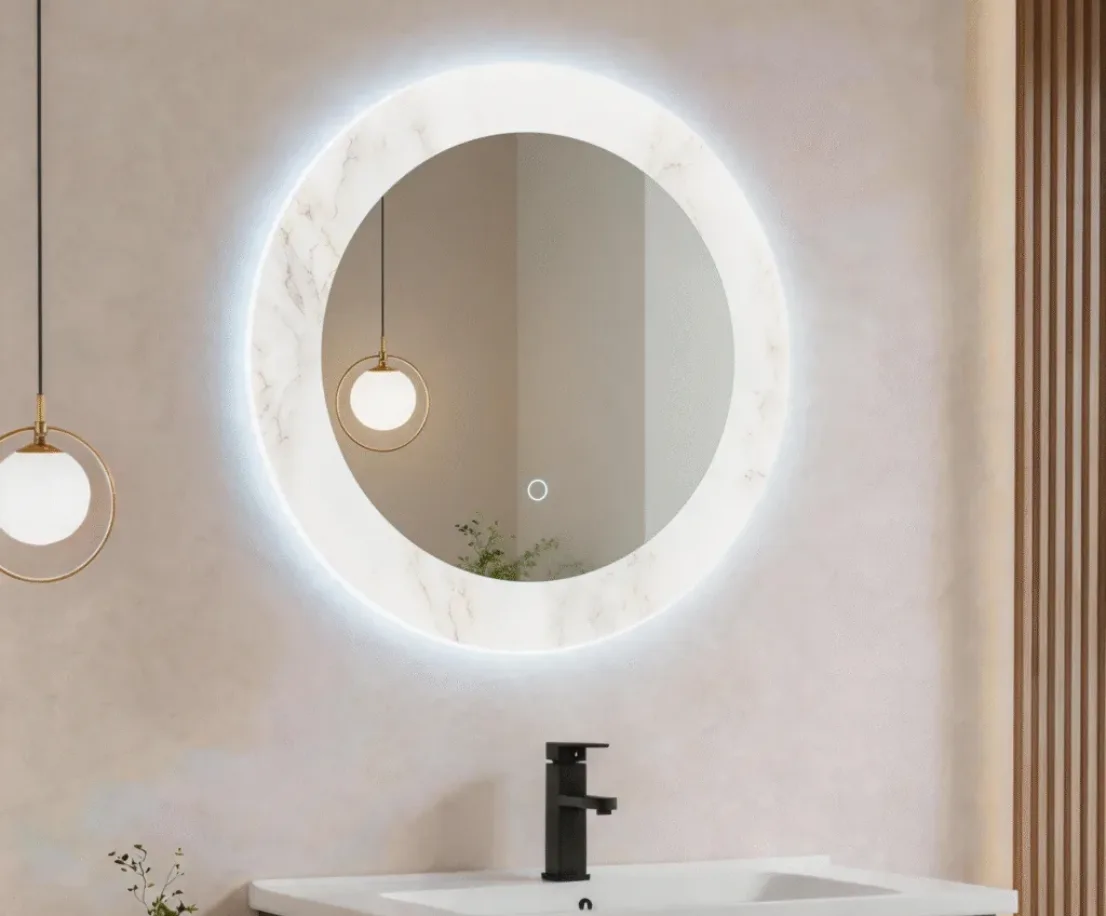
Aosmay24×24 Inches Round LED Bathroom Mirror with Marble-Pattern Acrylic Backlit
4. How Do Your Testing Protocols Support Scalable Compliance (UL, ETL, CE, RoHS)?
Navigating international electrical compliance is one of the most complex aspects of an OEM/ODM partnership. If a custom design arrives at a U.S. or European port without verified safety credentials, customs officials can impound the entire container, causing devastating project delays and financial loss.
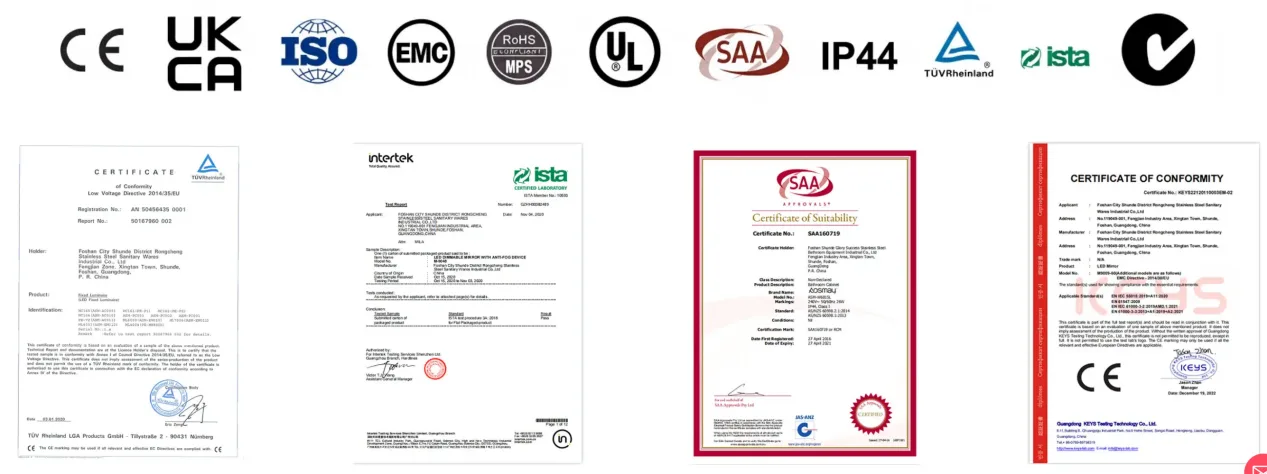
Ask the manufacturer to detail their compliance engineering framework. A high-capacity factory possesses a comprehensive library of existing UL, ETL, and CE certifications. When you request a custom size or a specific lumen output, their engineers can perform a structural and electrical evaluation to utilize their existing certification files, rather than starting a costly, months-long testing process from scratch. Ensure they guarantee that the entire LED driver and electrical housing system is IP44 waterproof-rated for safe operation in wet commercial zones.
5. Can You Demonstrate a “Dual-Engine” Logistics and Replenishment Strategy?
Even the most precisely engineered architectural mirror is a liability if it cannot arrive at the job site exactly when the installation schedule demands. Relying exclusively on standard trans-Pacific ocean freight introduces vulnerability to transit bottlenecks, port labor disputes, and ocean container shortages.
A sophisticated partner like an Aosmay OEM/ODM mirror factory operates a “Dual-Engine Supply Chain” to eliminate this logistical friction. The following operational matrix illustrates how this dual approach protects high-volume commercial projects:
Logistical Agility Matrix: FCL Ocean vs. Domestic Warehouse
Operational Vector | Primary Factory Direct Engine (FCL) | Local Overseas Warehouse Engine |
Logistical Role | High-Volume Baseline Rollout | Rapid Replenishment & Safety Buffer |
Customization Depth | Unlimited OEM/ODM Material & Dimensional Specs | Pre-cleared Standard Commercial Inventory |
Transit Velocity | Standard Ocean Transit Lead Times | Expedited Local Domestic Routing |
Strategic Advantage | Maximizes Unit-Cost Efficiency | Prevents Construction Delays & Stock-outs |
By partnering with a manufacturer that commands both an automated high-volume production facility and a network of strategic U.S. overseas warehouses, you gain absolute supply chain resilience. Your primary volume is custom-manufactured and shipped via cost-effective containers, while any unexpected site breakages, quantity miscalculations, or accelerated construction phases are seamlessly covered by pulling identical, pre-cleared inventory from the domestic warehouse for expedited local delivery.
6. Conclusion: Turning Sourcing Into a Competitive Advantage
Procuring custom illuminated mirrors for a large-scale commercial development is a continuous exercise in risk management. By replacing superficial price negotiations with hard technical questions regarding DFM structural integrity, galvanic corrosion defense, optical diffusion, electrical compliance, and dual-engine logistical buffers, you shift the power dynamic back into your hands.
An elite manufacturing partner will always provide data-driven, precise answers to this checklist. Establishing these rigid baseline requirements protects your project’s budget and ensures your properties deliver a flawless, high-end guest experience from day one.
[Contact Our OEM/ODM Engineering Team to Start Your DFM Review] or [Check Our U.S. Warehouse Availability for Expedited Local Dispatch].
7. FAQs
- Can a LED Bathroom Mirror Manufacturer provide private label and OEM branding?
Yes. Most manufacturers offer OEM services, including custom logos, branded packaging, user manuals, labels, and private-label production to help build your own brand.
- How do I verify the manufacturing capabilities of an OEM mirror factory?
Request factory audits, certifications, production videos, testing reports, and quality control procedures. A reliable Aosmay OEM/ODM mirror factory should be transparent about its manufacturing capabilities and project experience.
- Why work directly with an Aosmay OEM/ODM mirror factory instead of a trading company?
Working directly with an Aosmay OEM/ODM mirror factory offers better pricing, faster communication, stronger engineering support, and greater control over quality, customization, and delivery schedules.