
In the highly competitive commercial real estate and sanitary ware wholesale markets, the evaluation criteria for bathroom fixtures have fundamentally shifted. While external aesthetics and high-CRI illumination initially attract buyers, the long-term commercial success of a fixture is determined by its daily utility.
According to housing research published by the National Apartment Association (NAA) and RentCafe, the average size of newly built U.S. apartments has decreased by 54 square feet over the past decade, forcing a widespread reduction in overall bathroom footprints. To combat this ongoing spatial compression, the National Kitchen & Bath Association (NKBA) highlights in its recent design trends report that 72% of industry designers are now strictly prioritizing seamless, vertical storage solutions to eliminate clutter. This architectural reality has triggered a massive surge in demand for highly efficient storage fixtures. Consequently, the internal architecture of a lighted mirror medicine cabinet is no longer a secondary consideration; it is the primary driver of end-user satisfaction and brand loyalty.
For procurement directors, interior designers, and distributors, understanding the engineering behind internal shelving is critical. The design, materiality, and adjustability of a single shelf can instantly position a product as a cheap retail commodity or a luxury commercial asset. This whitepaper deconstructs the science of spatial engineering and explores how structural decisions impact the market positioning of modern vanity storage.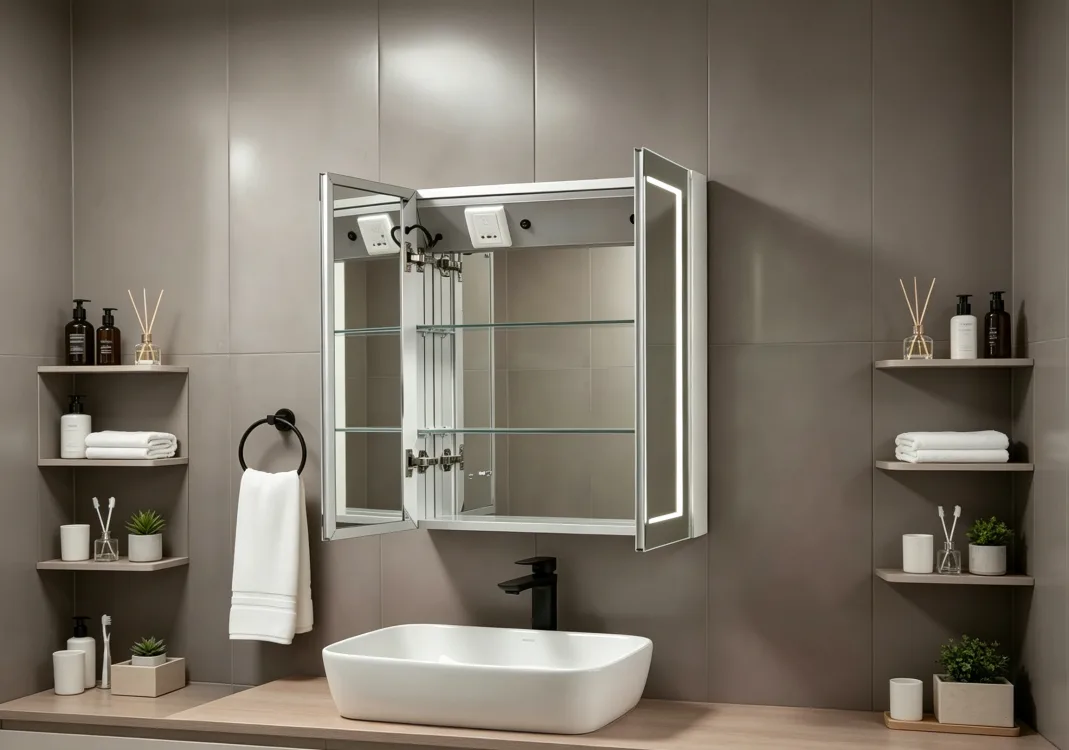
1. The 2026 Market Reality: The Economics of Volume
To understand the importance of internal shelving, B2B buyers must look at the data driving consumer behavior. A 2026 global consumer analytics report on sanitary ware revealed that “Insufficient Storage Adjustability” is the number one cause of negative post-purchase reviews for bathroom cabinets, outpacing electrical failures by a 3-to-1 margin.
In modern households, the variety of grooming products has exploded. The average user now stores electric toothbrushes (requiring vertical height), heavy premium skincare jars (requiring weight-bearing strength), and small cosmetic items (requiring shallow, accessible trays). When a distributor imports a cabinet with poorly designed, rigid internal architecture, they are guaranteeing a frustrating user experience, leading to high retail return rates and damaged brand reputation.
In commercial hospitality, the stakes are equally high. Hotel designers meticulously calculate the volume required for folded towels, amenities, and guest toiletries. A cabinet that fails to optimize its internal cubic volume is a liability to the room’s overall spatial efficiency.
2. The Ergonomics of a Medicine Cabinet Shelf
The difference between standard manufacturing and elite architectural engineering lies in the application of human ergonomics. Designing the perfect medicine cabinet shelf requires balancing depth, vertical increments, and accessibility.
The “Golden Reach Zone”
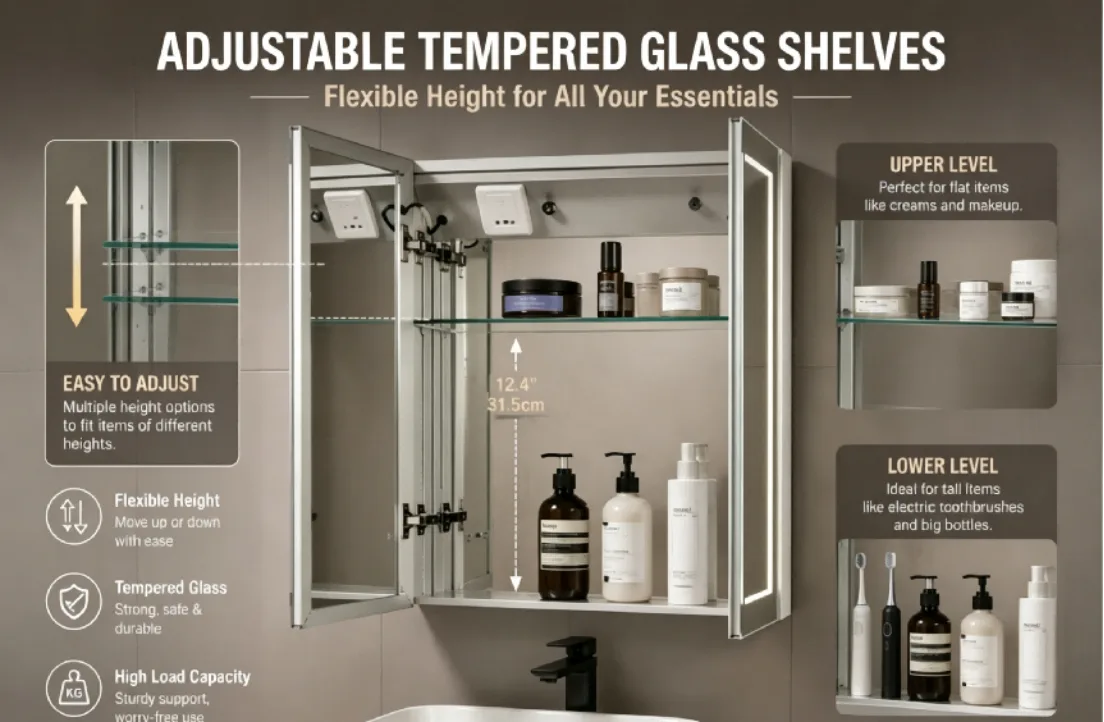
Ergonomic science dictates that the most frequently used items should be stored within a 15-degree visual and physical reach arc from the user’s standing eye level. Premium cabinets maximize this “Golden Reach Zone” by utilizing fully adjustable shelving systems. By allowing the user to micro-adjust the shelf heights in increments as small as one inch, the cabinet adapts to the user’s specific ergonomic needs, rather than forcing the user to adapt to the cabinet.
Depth-to-Width Ratios
Commercial specifiers must also evaluate the depth of the shelf. If a shelf is too shallow (under 3 inches), it cannot accommodate standard electric razors or modern skincare bottles. If it is too deep (over 6 inches on a surface-mount unit), it creates a dark cavern where smaller items are lost in the back, and the cabinet itself begins to encroach aggressively into the user’s washing space over the vanity. The industry gold standard for luxury commercial applications maintains an internal shelf depth of exactly 3.5 to 4.5 inches—perfectly balancing storage capacity with a sleek external profile.
3. Materiality in a Commercial Lighted Mirror Medicine Cabinet
The materials used for the internal shelving directly communicate the product’s market positioning. A buyer opening a beautifully illuminated mirror only to find cheap, warping plastic shelves immediately associates the entire product with low quality.
The Problem with Fixed Metal or MDF Shelves
Economy-tier products often utilize fixed shelves made of thin sheet metal or laminated MDF (Medium-Density Fiberboard). MDF is highly susceptible to moisture expansion in wet zones, and fixed metal shelves block ambient light from traveling down through the cabinet, creating dark, uninviting storage compartments. Furthermore, fixed shelves severely limit the user’s ability to store oversized items, immediately degrading the user experience.
The Luxury Standard: Architectural Tempered Glass
Premium commercial fixtures universally employ Tempered Architectural Glass for their internal shelving. Tempered glass offers three distinct engineering advantages:
- Optical Clarity: Glass shelves allow the ambient light from the room to pass freely through the interior of the cabinet, illuminating all levels naturally without the need for complex internal wiring.
- Chemical Resistance: Glass is completely impervious to bathroom humidity, cosmetic spills, and harsh chemical cleaners, ensuring it will never rust, warp, or stain.
- Load-Bearing Strength: When paired with heavy-duty metal shelf clips, 8mm tempered glass can support the significant weight of heavy glass cosmetic jars and grooming appliances without bowing.
4. How Internal Architecture Defines Product Positioning
For wholesale distributors, the internal configuration is the ultimate tool for market segmentation. The following data matrix illustrates how variations in shelf engineering directly dictate a product’s target demographic and commercial lifespan.
Commercial Positioning & Shelf Engineering Matrix
Engineering Specification | Economy Retail Tier | Mid-Market Wholesale | The Aosmay Commercial Standard |
Shelf Material | Injection Molded Plastic / MDF | Standard 5mm Glass | 7-8mm Tempered Architectural Glass |
Adjustability Mechanics | 2-3 Fixed Position Slots | Limited Pre-Drilled Holes | Infinite Micro-Track Adjustability |
Hardware / Support | Integrated Plastic Notches | Brittle Plastic Clips | Heavy-Duty Metal Shelf Clips |
Internal Volume | Reduced by Thick Plastic Walls | Compromised by Internal LEDs | 100% Dedicated Storage (No Internal LEDs) |
Target Application | DIY Consumers, Flipped Homes | Low-Budget Motels, Rentals | Luxury Hospitality, High-End Developers |
As demonstrated in the matrix, the jump from mid-market to the luxury commercial standard is entirely dependent on eliminating fragile materials (plastic clips) and maximizing usable volume.
5. The Aosmay Lighted Medicine Cabinet: Precision Internal Architecture
When global developers and high-end distributors source an Aosmay lighted medicine cabinet, they are investing in the pinnacle of luxury commercial spatial engineering. Aosmay approaches the internal architecture of a cabinet with the same rigor as the exterior metal fabrication.
Our engineering philosophy for internal storage is built on three uncompromising pillars:
100% Dedicated Storage Volume
A critical flaw in many trending “smart” cabinets is the inclusion of internal LED light strips. While visually flashy, these internal electronics consume valuable interior depth, restrict shelf adjustability, and introduce high-voltage failure points inside a heavily humid, closed environment. Aosmay engineers deliberately omit internal lighting hardware. By keeping the interior purely structural, we maximize the absolute cubic volume for storage and eliminate hidden maintenance risks, presenting a flawlessly clean, reliable interior for the commercial end-user.
Heavy-Duty Metal Support Systems
The integrity of a medicine cabinet shelf relies entirely on the chassis holding it. Aosmay manufactures incredibly rigid metal bodies using anodized aluminum, stainless steel, or powder-coated iron. This unyielding frame allows us to utilize heavy-duty, commercial-grade metal shelf clips. Unlike plastic clips that fail under weight, our metal brackets lock the tempered glass shelves firmly in place, ensuring they can bear the weight of heavy hotel amenities without a millimeter of sag.
Infinite Adjustability for Minimalist Aesthetics
Catering to the high-end European and North American preference for clean, minimalist design, Aosmay integrates highly discreet, micro-adjustable track systems within the metal chassis. This allows the end-user to configure their tempered glass shelves exactly to their lifestyle, maintaining a pristine, organized interior that perfectly complements the high-CRI illumination and intuitive capacitive touch controls (engineered with precise blue-to-white status indicators) on the exterior mirror.
6. Conclusion: Procuring for the End-User Experience
In the modern supply chain, it is easy to become distracted by exterior electronics and lowest-cost sourcing. However, procurement professionals must remember that the end-user interacts with the inside of the cabinet every single day.
By analyzing the 2026 market demand for high-efficiency vertical storage and understanding the profound impact of ergonomic, adjustable tempered glass shelving, buyers can elevate their product offerings. Partnering with a manufacturer that prioritizes rigorous internal spatial engineering over superficial retail gimmicks ensures that your wholesale catalog or commercial property delivers a truly premium, lifelong user experience.
[Explore the Architectural Specifications of Aosmay Medicine Cabinets] or [Contact Our Engineering Team to Discuss Custom Storage Solutions].
7. FAQs
1. What should I look for in a lighted mirror medicine cabinet?
A high-quality lighted mirror medicine cabinet should offer adjustable shelving, tempered glass shelves, durable metal construction, LED lighting, anti-fog features, and sufficient storage capacity. These features improve both daily usability and long-term durability.
2. What is the best material for a medicine cabinet shelf?
Tempered glass is widely considered the best material for a medicine cabinet shelf because it resists moisture, supports heavy toiletries, and allows light to pass through the cabinet.
3. Are adjustable medicine cabinet shelves worth it?
Yes. Adjustable medicine cabinet shelf systems allow users to store items of different heights, from skincare bottles to electric toothbrushes. Flexible storage is one of the most requested features in modern bathroom storage solutions.
4. How deep should a medicine cabinet shelf be?
Most premium medicine cabinet shelf designs have an internal depth of approximately 3.5–4.5 inches (90–115 mm). This provides enough space for everyday toiletries while maintaining a slim cabinet profile.